April 25, 2026
Key Takeaways
- Coastal yards in Jax Beach and Atlantic Beach face high winds, sandy soil, and constant salt spray.
- The Sabal Palm and Southern Red Cedar are the toughest frontline trees for oceanfront properties.
- Salt spray causes physiological drought, so you need trees with waxy or needle-like leaves that don’t lose moisture easily.
- Native Florida species handle our specific Nor’easters and hurricane seasons much better than exotic imports.
- Proper tree placement can actually protect your home’s structure and help prevent shoreline erosion.
If you’ve ever walked out to your car in Jax Beach on a humid morning, you’ve seen that thin, crusty layer of salt on the windshield. Now, imagine being a tree and having that salt sitting on your skin 24 hours a day, 365 days a year. It’s brutal. For most plants, salt spray is like a slow-motion poison; it sucks the moisture right out of the leaves, leaving them brown, crispy, and dead.
As we get into the 2026 planting season, beach homeowners are looking for more than just a pretty yard; they want resilience. With the storms we’ve seen lately, the wrong tree is just a liability waiting to happen. If you’re living in Atlantic Beach or Jax Beach, you need trees that don’t just survive the salt but actually thrive in it. Here is the breakdown of what actually works out here in the sand.
The Frontline: Trees That Love the Salt Spray
If your house is right on the dunes or within a block of the ocean, you’re in the splash zone. These trees are the Navy SEALs of the plant world.
1. Sabal Palm (Sabal palmetto)
You can’t talk about Florida beaches without the Sabal Palm. It’s our state tree for a reason. It doesn’t have a big, heavy canopy to catch the wind, so it rarely blows over. Its roots are like a giant underground sponge that holds the sand together, which is huge for preventing erosion. In 2026, it’s still the #1 choice for frontline coastal landscaping.
2. Southern Red Cedar (Juniperus virginiana var. silicicola)
Southern Red Cedar is the Old Reliable of Atlantic Beach. If you look at the older homes in the area, you’ll see these tall, rugged evergreens everywhere. Their needles are covered in a natural wax that shrugs off salt spray like a raincoat. They make incredible windbreaks if you’re trying to create a protected pocket for a patio or a pool.
3. Sea Grape (Coccoloba uvifera)
Sea Grapes are fascinating because they look so tropical with those huge, dinner-plate leaves. Those leaves are thick and leathery, specifically designed to handle the abrasive sand and salt. They’re technically a large shrub, but you can easily train them into a beautiful, multi-trunk tree that provides tons of privacy.
If you’re a few blocks inland, west of 3rd Street, you have a bit more flexibility. You still get the salt in the air during a storm, but the daily mist isn’t as intense.
4. Southern Live Oak (Quercus virginiana)
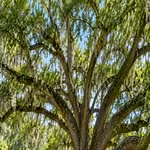
The Live Oak is the king of the South. While they don’t love being sprayed directly with salt water every day, they are incredibly tough once they’re established. They grow low and wide, which helps them duck under the worst of the ocean winds. Their root systems are legendary for keeping a property stable during a surge.
5. Yaupon Holly (Ilex vomitoria)
If you want something that stays green all year and feeds the local birds, the Yaupon is your best bet. It’s a native that doesn’t mind the high-pH, alkaline soil we have at the beach. It’s virtually indestructible and can be pruned into almost any shape you want.
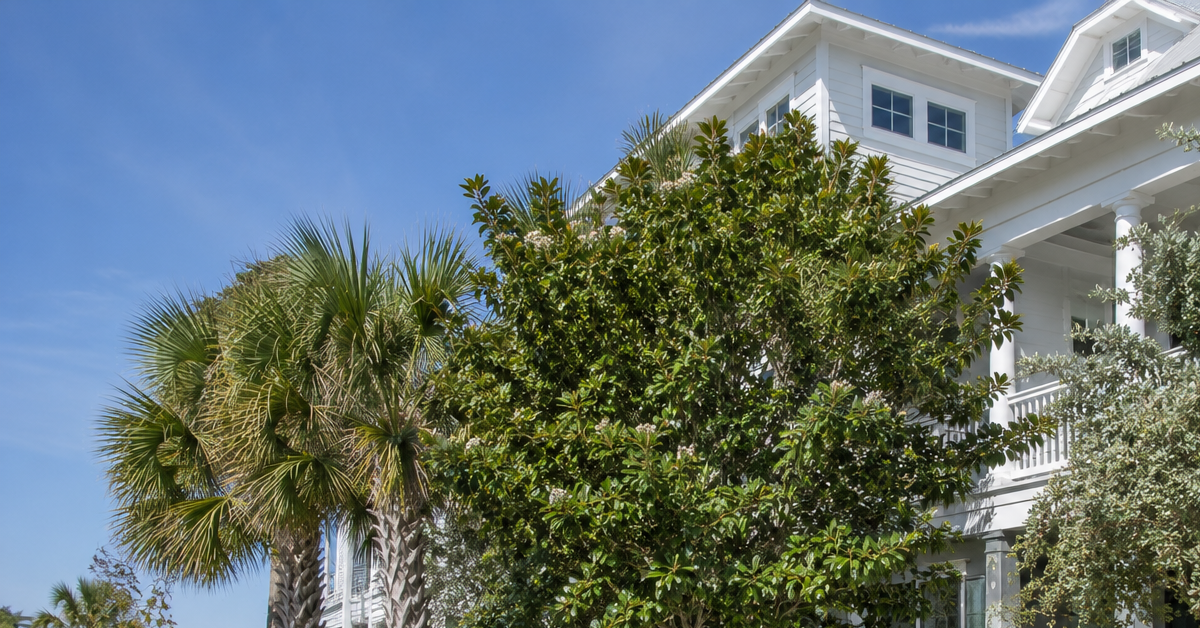
6. Southern Magnolia (Magnolia grandiflora)
For a bit of classic elegance in Atlantic Beach, the Southern Magnolia is a winner. Those big, shiny, waxy leaves aren’t just for show; that wax is a shield against salt. In 2026, many people are opting for the Little Gem variety because they fit better on the smaller lots we have at the beach.
Why Coastal Trees Struggle (and How to Help)
The biggest mistake people make is thinking that a salt-tolerant tree can just be stuck in the sand and forgotten. In reality, the first six months are critical. Even a Sabal Palm needs fresh water to get its roots moving. If you plant a new tree and a Nor’easter blows in two weeks later, you need to get out there with a hose and rinse the salt off the leaves as soon as the wind dies down.
Beach soil is also notoriously hungry. It’s mostly crushed shell and sand, which means it doesn’t hold nutrients well. When we plant out here, we always recommend mixing in some good organic compost to give those roots a fighting chance.
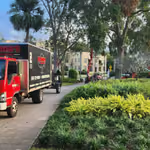
Living on the coast is beautiful, but it takes a toll on your trees. Since 1962, Bushor’s Tree Surgeons has been the go-to tree service expert for homeowners in Jax Beach, Atlantic Beach, and throughout Northeast Florida. As a family-owned business with three generations of ISA Certified Arborists, we know exactly which trees can handle the salt and which ones are just waiting to fall.
We specialize in safe tree removal, precision tree removal, tree trimming and pruning, and 24/7 emergency tree services following storm damage. Our team also provides expert tree health care, tree cabling, and bracing to support heavy limbs and stump removal or grinding. Bushor’s Tree Surgeons use professional equipment, including bucket trucks and cranes, to ensure every cut is clean and within your property boundaries. Whether you are in Ponte Vedra, Orange Park, or the heart of Jacksonville, our arborists offer honest risk assessments and transparent flat-rate pricing. Trust our A+ BBB rating and commitment to quality tree care.
Frequently Asked Questions by Homeowners in FL
1. Can I plant a Pine tree at the beach in Florida?
Some pines, like the Slash Pine, handle the coast okay, but they are prone to snapping in high winds. The Southern Red Cedar is a much safer, more salt-tolerant evergreen option for beach dwellers.
2. My tree looks brown after a storm. Is it dead?
Not necessarily. It might just have salt burn. If the branches are still flexible and there’s green underneath the bark when you scratch it, the tree is likely just stressed. Give it plenty of fresh water and wait for new growth.
3. Do salt-tolerant trees need fertilizer in FL?
Yes, but be careful. Because beach soil drains so fast, you want a slow-release fertilizer so the nutrients don’t just wash away into the groundwater.
4. Is there a tree that blocks the wind but doesn’t block my view?
This is a tough balance! Many people use lifted Live Oaks or Sea Grapes that are pruned to have a clear view at eye level, while the canopy provides shade and wind protection above.
5. How often should I water a new tree at Jax Beach, FL?
For the first few months, you should water every day. The sand dries out incredibly fast, and young roots can’t find deep water on their own yet.
6. Are there any flowering trees that like the salt?
The Oleander (technically a large shrub/small tree) and the Vitex (Chaste Tree) both have beautiful blooms and handle the coastal air quite well.
7. Can I use ocean water to irrigate my salt-tolerant trees?
Absolutely not. Salt-tolerant means they can handle the spray in the air, but very few trees can survive having their roots soaked in saltwater for long.
8. Do I need a permit to trim my oaks in Atlantic Beach, FL?
Yes, Atlantic Beach has very specific rules about how much you can trim and when. It’s always best to check with a pro before you start cutting to avoid a city fine.
Summary Checklist: Coastal Tree Success
| Condition | Risk Level | Recommended Action |
|---|---|---|
| Direct oceanfront exposure | Critical | Select salt-tolerant species such as Sabal Palms or Southern Red Cedars for better coastal survival |
| High-wind coastal zone | High | Choose wind-resistant tree species like Live Oaks that handle storm exposure more effectively |
| Sandy or poorly drained soil | Moderate | Improve planting conditions with organic compost and proper soil preparation |
| Visible salt burn on foliage | Moderate | Rinse leaves with fresh water after storms to reduce salt buildup and foliage stress |
| Narrow coastal property | Low | Use compact tree varieties like Little Gem Magnolia, where space is limited |
Final Advice
Achieving success with coastal arboriculture in 2026 necessitates the selection of the appropriate biological assets tailored to the specific demands of the environment. Attempting to override the natural conditions of the Atlantic coastline is an exercise in futility; rather, one must operate in alignment with them. For properties situated on the immediate shoreline, it is essential to avoid introducing species native to inland forests and instead prioritize palms and cedars that have evolved over millennia to withstand high salinity.
Homeowners should prioritize native species, as these organisms are biologically adapted to Northeast Florida’s distinct humidity levels and cyclical storm patterns. Should the vitality of a tree appear compromised following a severe Nor’easter, immediate professional intervention is advised. Implementing preventative care and structural mitigation today can preclude the substantial financial burden of emergency removal in the future. We have been dedicated to preserving the canopy of Jacksonville’s beach communities for more than six decades. For expert consultation or comprehensive management of your coastal landscape, contact Bushor’s Tree Surgeons at (904) 789-8884.