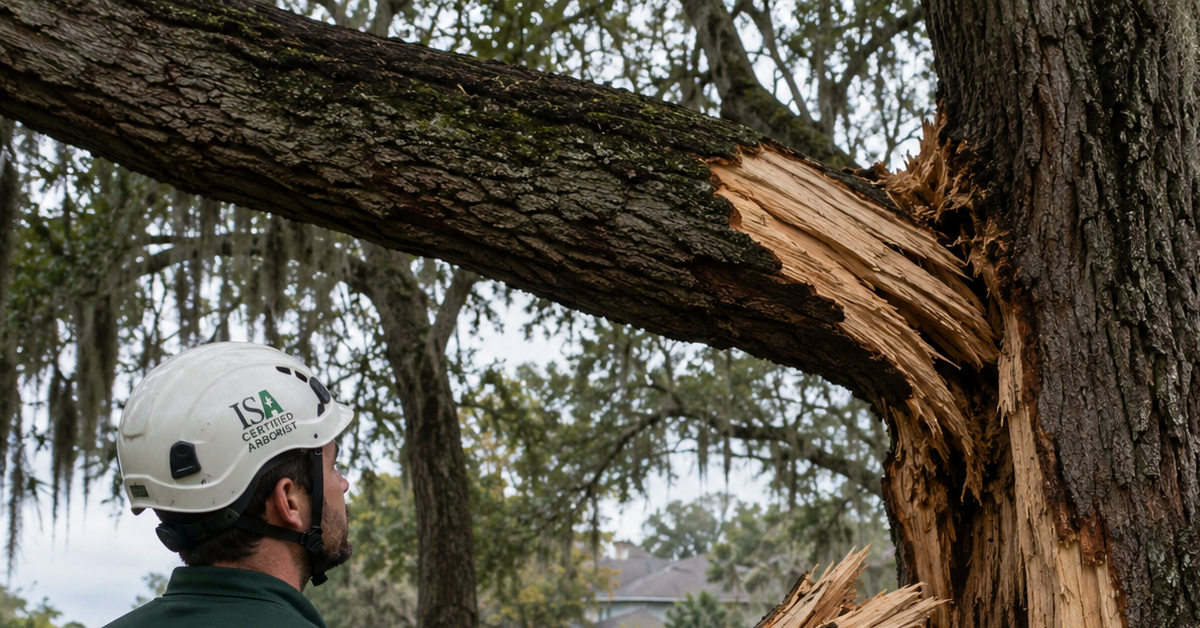
Key Takeaways:
- Immediate Hazards: Identify widowmakers or hanging limbs that pose an instant threat to people and structures.
- Root Integrity: Look for heaving or mounded soil at the base, which indicates structural instability.
- Hidden Fractures: Check the trunk and main unions for vertical cracks or bleeding sap that suggests internal stress.
- Leaning Shifts: Any new or sudden lean in a tree following high winds is a critical emergency.
- Professional Assessment: Many wind-damaged trees can be saved through cabling or bracing if caught early by a professional.
In Northeast Florida, the beauty of our sprawling live oaks and towering pines comes with a seasonal challenge: high-velocity winds. Whether from a summer thunderstorm or a tropical system moving up the Atlantic coast, wind exerts immense pressure on a tree’s canopy, trunk, and root system. For Jacksonville homeowners, knowing how to spot the subtle signs of wind damage is not just about landscape aesthetics; it is about property safety and liability.
Wind damage is not always as obvious as a fallen trunk. Often, the damage is structural and internal, creating a time bomb that may not fail until the next minor breeze. This guide provides a comprehensive walkthrough on how to evaluate your trees following high-wind events.
The Physics of Wind Loading
To inspect a tree properly, it helps to understand how wind affects it. Trees are natural dampers; they sway to dissipate energy. However, when winds reach critical velocity, the force can exceed the wood’s fiber strength or the soil’s holding power. In Jacksonville’s sandy soils, saturated ground from heavy rains often accompanies wind, making root failure more common than wood breakage in certain species.
1. The Ground-Up Inspection: Root Plate and Base
Safety begins at the bottom. The root plate is the most critical structural component of the tree.
- Soil Heaving: Look for lifting on the side of the tree opposite the wind direction. If you see a mound of soil or exposed fresh roots, the tree has partially uprooted. This is a critical failure.
- Soil Cracking: Radial cracks in the soil around the base suggest the root ball has shifted.
- Fungal Growth: While not caused by wind, if high winds have stressed a tree, existing decay (indicated by mushrooms or conks at the base) becomes much more dangerous.
2. Trunk Stress and Structural Fractures
The trunk acts as a lever. During a storm, the middle of the trunk bears the brunt of the bending moment.
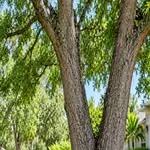
- Vertical Cracks: Look for new seams or deep vertical splits. These often occur in trees with included bark (where two trunks grow too close together).
- Lightning Scars: In Jacksonville, wind and lightning often go hand-in-hand. Look for a strip of blown-off bark running down the length of the tree.
- Compression Wrinkles: On the side of the tree that was leaning into the wind, look for buckled bark. This indicates the wood fibers were crushed under the pressure.
3. The Canopy and Widowmakers
The most common form of wind damage is the loss of limbs. Even if a limb hasn’t fallen, it may be hung up.
- Hangers: Branches that have broken off but are caught in the lower canopy are nicknamed widowmakers for a reason. They can fall at any time without warning.
- Leaf Scorching: Sometimes, salt spray from coastal winds or simple wind burn can turn leaves brown. While unsightly, this is usually a physiological stress rather than a structural one.
- Thinning Canopy: If you notice significantly more light coming through the canopy than before the storm, the tree may have lost internal lateral branches that provide wind resistance.
Assessing Specific Jacksonville Species
Different trees in Northeast Florida react differently to wind:
- Live Oaks: These are generally wind-resistant due to their lateral growth and strong wood, but they are prone to losing large over-extended limbs.
- Pine Trees: Pines are flexible but can snap mid-trunk if the wind is oscillating at the tree’s natural frequency.
- Palm Trees: Highly wind-resistant, but heart rot can cause the entire head to blow off in extreme conditions.
When Is a Lean an Emergency?
A tree that has always leaned is generally not a concern, as it has grown reaction wood to compensate. However, if a tree was straight yesterday and is leaning today, it is a structural emergency. Check the ground on the opposite side of the lean; if the soil is mounded or roots are visible, the tree is in the process of falling.
For over 60 years, Bushor’s Tree Surgeons has been the trusted name for storm recovery and hazard mitigation in Jacksonville. We provide 24/7 emergency services to Duval, St. Johns, and Clay counties. Our ISA Certified Arborists specialize in identifying hidden wind damage and providing solutions like cabling, bracing, or safe removal. Whether you are in Atlantic Beach or Mandarin, our team is ready to protect your home with professional expertise and transparent pricing. Contact us today at (904) 789-8884 for a free professional estimate.
Frequently Asked Questions by Homeowners in Jacksonville, Florida
1. Can a wind-damaged tree be saved in Jacksonville, Florida?
Yes. If the damage is limited to broken limbs or minor structural stress, techniques like crown reduction and cabling can often stabilize the tree.
2. How do I know if a crack in the trunk is dangerous?
If the crack goes through the bark into the wood, or if two cracks are on opposite sides of the trunk, the structural integrity is compromised.
3. What is included in bark, and why does it matter during storms?
Included bark occurs when two stems grow so close that bark is trapped between them. This creates a weak attachment point that is the first to split during high winds.
4. Should I remove a tree that is leaning toward my house after a storm in Jacksonville, Florida?
If the lean is new, yes. A sudden shift in lean indicates root failure, and the tree is no longer safe.
5. Does Jacksonville require a permit for removing a storm-damaged tree?
Generally, if a tree is an immediate hazard to life or property, emergency removal is permitted, but it is always best to document the damage with photos and consult a certified arborist.
6. Is stump grinding included in storm cleanup?
At Bushor’s Tree Surgeons, we offer stump grinding as an additional service to ensure your landscape is fully restored and safe for replanting.
7. How soon after a storm should I inspect my trees in Jacksonville?
As soon as it is safe to go outside. Hidden damage can become a secondary disaster in the days following a storm.
8. Why do some trees lose leaves after a big wind event?
This is often wind burn or salt desiccation. The tree may drop leaves to conserve water while it recovers from the stress.
Summary Checklist: When to Call for Removal
| Condition | Risk Level | Recommended Action |
|---|---|---|
| Soil heaving or lifting at the base | Critical | Stop activity in the immediate area, keep people clear, and arrange an urgent emergency professional response |
| New or sudden leaning | Critical | Treat it as a potential imminent failure and request an immediate structural assessment |
| Hanging limbs (widowmakers) | High | Secure the area beneath the canopy and arrange safe professional hazard removal |
| Vertical trunk splits | High | Schedule an urgent structural inspection to determine whether support systems or removal are necessary |
| Soil cracking at the base | Moderate to High | Arrange a professional stability evaluation to assess root plate movement and anchorage failure risk |
Final Advice
Taking the time to conduct a thorough post-storm inspection is the single most important step you can take to ensure the continued safety of your Jacksonville property. While a fallen limb is an obvious sign of trouble, the most dangerous hazards are often the ones that require a trained eye to detect, such as hairline fractures in the upper canopy or slight shifts in the root plate. If you notice any of the warning signs discussed in this guide, such as new leaning, mounded soil, or hanging widowmaker branches, do not wait for the next weather event to escalate the situation. High winds can compromise a tree’s internal vascular system and structural fibers long before the tree actually fails. A professional assessment from an ISA Certified Arborist is the only way to determine with certainty whether a tree can be salvaged through specialized cabling and bracing or if it must be removed to mitigate risk. Protecting your home, family, and neighbors starts with proactive maintenance and early detection of storm-related stress. At Bushor’s Tree Surgeons, we understand the specific challenges posed by Northeast Florida’s climate and have the advanced equipment necessary to handle even the most precarious removals. Our team is committed to preserving the health of your landscape while prioritizing the safety of your structures. Do not risk the liability and danger associated with a compromised tree; instead, rely on over six decades of local experience to guide your next steps.