April 22, 2026
The tree that gave you shade in five years might cost you $5,000 to remove in fifteen. That is the tradeoff most Jacksonville homeowners do not hear about when they pick fast-growing species from the nursery or inherit them from a previous owner. Fast growth sounds like a benefit. In many cases, it is the opposite. Trees that grow quickly almost always produce weaker wood, shallower root systems, and shorter lifespans. In Northeast Florida, where sandy soil, hurricanes, and prolonged summer rain already stress trees beyond what most regions deal with, fast-growing species fail earlier and more dramatically than they would elsewhere. This is not a warning against planting trees. Jacksonville needs its tree canopy. This is a guide to understanding which fast-growing species cause the most problems in our area, why they fail, and what you can plant instead to get shade, beauty, and structural reliability without the 15-year expiration date.
Key Takeaways
- Fast-growing trees produce softer, weaker wood that is more prone to storm damage, limb failure, and internal decay.
- Water oaks, laurel oaks, and Bradford pears are among the most commonly removed trees in Jacksonville due to age-related structural failure.
- Jacksonville’s sandy soil and storm exposure accelerate the decline of fast-growing species compared to slower-growing alternatives.
- Replacing a failing fast-grower with a long-lived species like live oak, bald cypress, or eastern red cedar saves money over the life of your property.
- Most fast-growing tree problems are predictable and preventable with the right species selection at planting time.
Why Fast Growth Creates Weak Trees
The biology behind this is straightforward. A tree that adds two to three feet of height per year is channeling most of its energy into rapid vertical and lateral extension. That growth comes at the expense of wood density. The cells in fast-growing wood are larger, thinner-walled, and contain more water than the tight, dense cells in slow-growing species. The International Society of Arboriculture describes this as the difference between structural wood and expendable wood. A live oak that grows 12 inches per year packs dense, interlocking fibers into every ring. A water oak that grows 30 inches per year produces wood that is softer, more porous, and significantly more vulnerable to decay fungi. This matters in Jacksonville for three specific reasons:
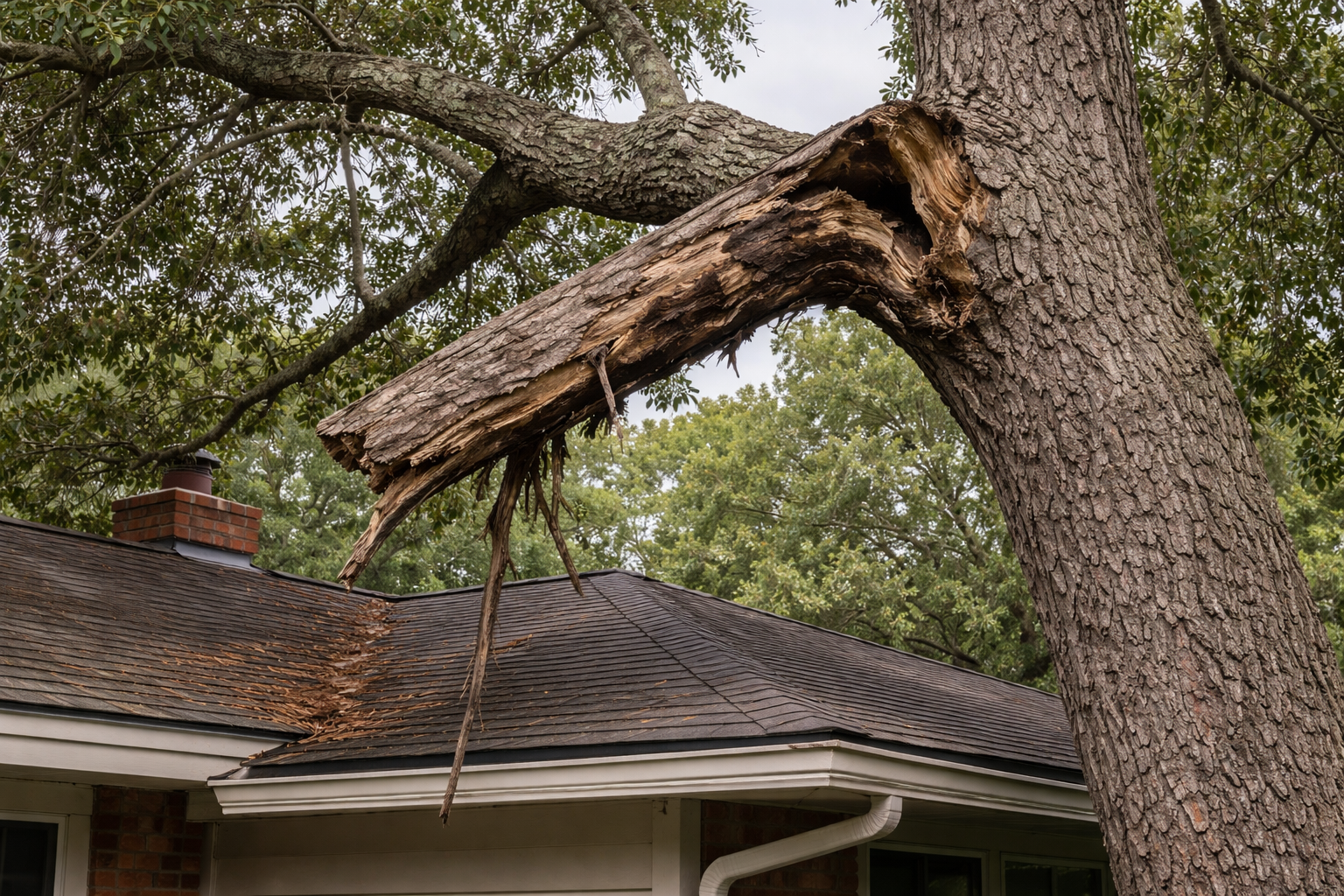
- Storm resistance: Weak wood snaps. During tropical storms and hurricanes, fast-growing species lose major limbs or split at branch unions far more often than dense-wood species. After every significant storm event in Duval County, the majority of the tree debris our crews clear comes from fast-growing species.
- Decay progression: Softer wood gives fungal pathogens like Ganoderma and Phytophthora easier entry and faster spread. A wound that a live oak compartmentalizes and walls off in months can become a column of internal rot in a water oak within a single growing season.
- Root system quality: Fast-growing trees in sandy soil tend to develop wide, shallow root plates with minimal vertical anchoring. When soil saturates during our June through September rainy season, these root systems provide less resistance to lean and wind throw than the deeper, denser root networks of slower-growing species.
The Most Problematic Fast-Growing Trees in Jacksonville
These are the species our certified arborists assess and remove most frequently across Duval, Clay, St. Johns, and Nassau counties.
Water Oak (Quercus nigra)
Water oaks grow fast and provide shade quickly, but they start falling apart around year 15 to 20. The University of Florida classifies its lifespan at roughly 30 to 50 years, which is short for an oak. The real issue is how they decline. They develop heavy limbs with weak attachment points. The wood is softer than other oaks. Internal decay begins in the trunk and major branch unions well before external symptoms appear. In our sandy soil, water oaks develop notoriously shallow root systems. After three or four days of heavy rain, the saturated ground cannot hold the root plate, and the entire tree can lean or topple with minimal wind. This is the most common emergency removal we handle in Jacksonville. Trees planted near driveways or foundations have restricted root zones that make them even less stable.
Laurel Oak (Quercus laurifolia)
Often confused with water oaks, laurel oaks share the same weaknesses but decline faster. Many begin showing serious structural problems around year 20 in Northeast Florida. They are extremely sensitive to root suffocation during soil saturation. Once root health declines, the canopy thins from the top down, large dead limbs appear, and the trunk becomes susceptible to Ganoderma and other wood-decay fungi. We see more laurel oak removals in Mandarin, Julington Creek, and Ponte Vedra than almost any other species.
Bradford Pear (Pyrus calleriana)
Now widely recognized as one of the worst landscape tree choices available. The Clemson Cooperative Extension has documented the core problem: Bradford pears develop tight, V-shaped branch unions where multiple leaders compete. These unions are inherently weak and split catastrophically as the tree matures. In Jacksonville, they rarely make it past 20 years without major structural failure. The Florida Invasive Species Council lists the parent species (Callery pear) as a Category II invasive.
Camphor Tree (Cinnamomum camphora)
Attractive when young, camphor trees develop aggressive, shallow root systems that crack foundations, lift sidewalks, and invade sewer lines. In Jacksonville’s sandy soil, these roots spread even more aggressively. The canopy becomes extremely heavy, creating significant wind load during storms. Camphor trees are classified as a Category I invasive by the Florida Invasive Species Council, meaning they are actively altering native plant communities.
Chinese Tallow (Triadica sebifera)
Also called popcorn tree, Chinese tallow is a prohibited species in Florida. The Florida Fish and Wildlife Conservation Commission lists it as illegal to plant, sell, or transport. Existing trees remain on many Jacksonville properties. The wood is brittle, the roots are shallow, and the tree produces chemicals that suppress native plant growth. If you have one, removal is recommended for both safety and ecological responsibility.
Arizona Cypress and Leyland Cypress
Both are planted for fast privacy screening. Both perform poorly long-term here. Arizona cypress is prone to fungal diseases in our humidity. Leyland cypress develops a narrow, top-heavy form that snaps, leans, and uproots in Jacksonville storms. Dense foliage catches wind rather than letting it pass, and the shallow root plate in sandy soil cannot handle the leverage. Both typically need removal within 15 to 20 years.
What to Plant Instead
The goal is shade, beauty, and structural reliability over a 50 to 100-year lifespan.
| Species | Growth Rate | Lifespan | Storm Resistance | Best For |
|---|---|---|---|---|
| Southern Live Oak | Moderate | 200+ years | Excellent | Shade, property value, long-term canopy |
| Bald Cypress | Moderate | 200+ years | Excellent | Wet areas, flood-prone sites |
| Eastern Red Cedar | Moderate | 50 to 80 years | Very good | Coastal, salt-tolerant screening |
| Winged Elm | Moderate to fast | 50 to 80 years | Good | Smaller yards, quick canopy |
| Shumard Oak | Moderate | 100+ years | Very good | Fall color, large canopy |
| Dahoon Holly | Moderate | 40 to 60 years | Good | Understory, wet sites, wildlife |
| Sabal Palm | Slow to moderate | 75+ years | Excellent | High storm resistance, native landscape appeal |
A Southern live oak grows roughly 12 to 24 inches per year instead of the 30 to 48 inches a water oak produces. But by year 30, the live oak is a dense, storm-resistant anchor with a lifespan measured in centuries. The water oak, if it has made it that long, is likely a removal candidate. The University of Florida IFAS Extension maintains detailed species profiles, including soil requirements, mature size, and wind resistance ratings.
How to Know If Your Fast-Growing Tree Is Already Declining
If you already have water oaks, laurel oaks, or other fast-growing species on your property, here is what to watch for:
- Upper canopy dieback: Dead branches appearing at the top of the tree, where water pressure is greatest, signal that the root system can no longer support the full crown.
- Fungal conks at the base or trunk: Shelf-like growths indicate active wood decay inside the trunk or root flare. By the time conks are visible, internal damage is typically extensive.
- Bark falling off or peeling: Sections of loose or missing bark, especially on the lower trunk, suggest decay or cambium death underneath.
- Multiple large dead limbs: One dead branch can be normal. Three or four large dead limbs spread across the canopy indicate systemic decline.
- Leaning or soil heaving after rain: The root plate has lost its grip in saturated sandy soil. This is a structural emergency, especially for trees over 30 feet tall.
- Carpenter ants or boring insects: Insects colonize weakened and decaying wood. Their presence often confirms that internal deterioration is already advanced.
Field Insight: The most common pattern we see in Jacksonville is a 25 to 30-year-old water oak that looks mostly fine from the street. The homeowner calls because one large limb dropped without warning. When our arborists assess the tree, they find extensive internal decay, multiple weak branch unions, and a root system compromised by years of soil saturation. The tree that “just lost a branch” actually needs removal. The limb failure was the symptom, not the problem.
When to Call a Professional
Call immediately if you see:
- A large dead limb hanging in the canopy of a fast-growing tree
- A sudden lean in any tree, especially after rain
- Fungal conks or mushrooms at the base of a mature water oak, laurel oak, or camphor tree
- A tree that dropped a major limb without any storm event
Schedule an inspection if you notice:
- Gradual canopy thinning or upper dieback
- Multiple dead branches developing over a season
- Bark damage, peeling, or discoloration on the trunk
- Any fast-growing species over 20 years old near a structure, driveway, or power line
Frequently Asked Questions
Are water oaks bad trees?
Water oaks are not bad trees in a forest setting, where their short lifespan is part of a natural cycle. In a residential landscape where they grow over homes, driveways, and power lines, their weak wood, shallow roots, and 30 to 50 year lifespan make them a poor long-term investment. They are the single most commonly removed tree species in Jacksonville for a reason.
How fast do live oaks grow compared to water oaks?
Live oaks grow roughly 12 to 24 inches per year. Water oaks grow 24 to 48 inches per year. The difference narrows as trees mature. By year 20, a well-maintained live oak has a substantial canopy, dense storm-resistant wood, and a root system built for the long haul. The water oak is typically beginning its decline phase.
Should I remove a healthy-looking water oak?
Not necessarily. A water oak that is structurally sound, properly maintained, and not over a high-value target (home, vehicle parking, play area) can continue to provide shade for years. The key is having a certified arborist assess it periodically. Once signs of internal decay, major deadwood, or root compromise appear, plan for removal rather than waiting for failure.
What is the best shade tree for Jacksonville?
Southern live oak is the clear winner for most residential properties. It is storm-resistant, long-lived, tolerates sandy soil and salt exposure, and develops one of the most beautiful canopy forms of any North American tree. For wet sites, bald cypress is equally reliable. For smaller yards, Shumard oak or winged elm offer good canopy coverage with a more manageable footprint.
Can I save a fast-growing tree that is already declining?
It depends on how far the decline has progressed. If the issue is limited to a few dead branches and early canopy thinning, structural pruning and improved care (mulching, drainage correction, avoiding root zone damage) can extend the tree’s useful life by several years. If internal decay is advanced, fungal conks are present, or the root system is compromised, removal is usually the safer and more cost-effective option.
Is it illegal to remove a water oak in Jacksonville?
Jacksonville’s tree ordinance (Chapter 656) protects trees with a trunk diameter of 8 inches or more at chest height (4.5 feet). You generally need a permit to remove protected trees on your property. However, the city makes exceptions for trees that are dead, dying, diseased, or deemed hazardous by a certified arborist. A professional risk assessment can support your permit application.
Choosing the Right Tree Saves Money for Decades
Most of the expensive tree emergencies in Jacksonville are predictable. They involve fast-growing species that were planted for quick results and became structural liabilities within two decades. The best time to address this is before planting. The second-best time is now, before the next hurricane season puts your aging fast-grower to the test; it may not pass. If you have fast-growing trees on your property and are unsure about their condition, a professional assessment gives you a clear picture of what you are working with and what your options are.
Concerned About a Tree on Your Property? Bushor’s Tree Surgeons has served Jacksonville and Northeast Florida since 1962. Our ISA Certified Arborists can assess your trees, identify species-related risks, and recommend whether maintenance, monitoring, or removal is the right call. Call (904) 789-8884 or request a free estimate at bushortree.com
Reviewed by the ISA Certified Arborists at Bushor’s Tree Surgeons. Family-owned, serving Northeast Florida since 1962. Three generations of certified arborists with over 100 years of combined experience. Licensed, bonded, insured. BBB A+ rated. Serving Duval, Clay, St. Johns, and Nassau counties.