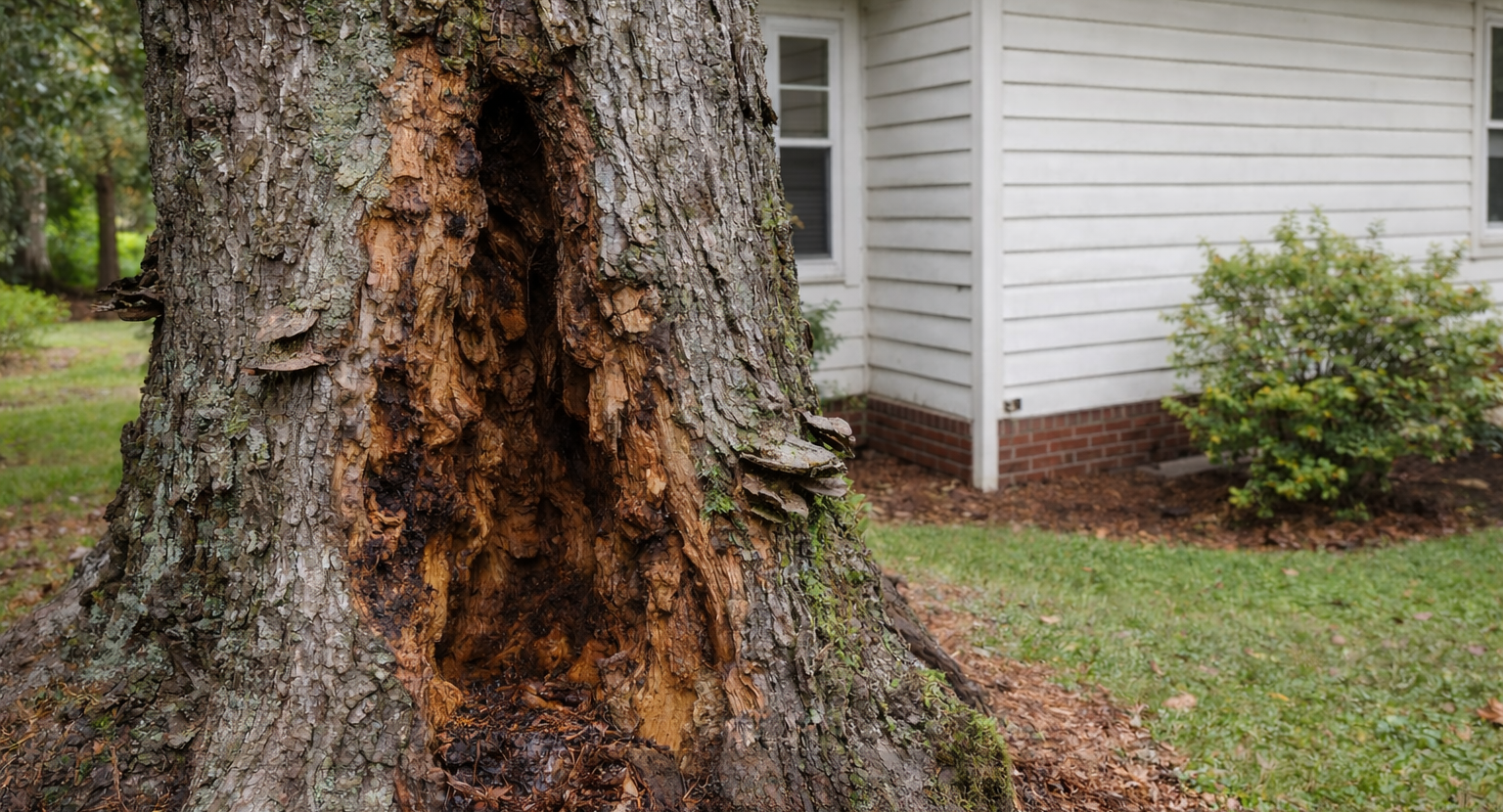
The majestic oaks and towering pines of Jacksonville provide more than just shade; they are integral to our property value and the local ecosystem. However, for many homeowners, these giants become a source of profound anxiety when signs of decay appear. Internal rot is a stealthy process, often hollowing out a tree’s structural core while the canopy remains deceptively green. If you have a large tree positioned within striking distance of your roof, driveway, or power lines, understanding the nuances of internal decay isn’t just a matter of botany; it is a critical part of home maintenance and disaster preparedness. This guide explores the science of tree decay, the unique risks posed by the Florida climate, and the advanced diagnostic methods professionals use to separate minor issues from catastrophic hazards.
Key Takeaways
- Internal rot weakens the ‘structural cylinder’ of the tree, making it susceptible to wind-load failure.
- Fungal fruiting bodies (conks) are the most reliable external indicators of advanced internal decay.
- The ‘Hazard Tree’ concept requires both a structural defect and a nearby target (like a house).
- Florida’s high humidity and sandy soils accelerate specific types of root and butt rot.
- Advanced technologies like Sonic Tomography allow for non-invasive ‘ultrasounds’ of tree trunks.
- Early detection through ISA Certified Arborist inspections can often save a tree through mitigation.
The Biology of Decay: How Rot Compromises Structure
To understand why internal rot is dangerous, we must first understand wood. Wood is composed primarily of two polymers: cellulose, which provides tensile strength (flexibility), and lignin, which provides compressive strength (rigidity). Wood-decay fungi (WDF) secrete enzymes that break down these polymers. White rot fungi consume both lignin and cellulose, leaving the wood soft and stringy. Brown rot fungi consume only cellulose, leaving the lignin behind in brittle, cube-like chunks. Both processes effectively turn a solid support pillar into a fragile shell. In the context of a 50-ton oak tree, this loss of structural integrity is a major safety concern. Trees do not ‘heal’ in the way humans do; instead, they use a process called CODIT (Compartmentalization of Decay in Trees). They attempt to wall off the decay using chemical and physical barriers. However, if the tree’s energy reserves are low or the fungal attack is aggressive, the rot will breach these walls and spread throughout the heartwood.
The Florida Factor: Why Jacksonville Trees Are at Higher Risk
Jacksonville’s environment is a ‘perfect storm’ for wood-decaying organisms. Our high annual rainfall and humidity provide the consistent moisture fungi need to thrive. Furthermore, our sandy, often poorly drained soils can lead to root stress, which invites opportunistic pathogens. One of the most significant local threats is Ganoderma zonatum, the fungus responsible for Ganoderma Butt Rot. Unlike other fungi that might take decades to kill a tree, Ganoderma can aggressively degrade the lower trunk and root flare of both palms and hardwoods. In a hurricane-prone region, this is particularly dangerous. When a hurricane’s wind load hits a tree, the forces are concentrated at the base. If that base is softened by Ganoderma or other ‘butt rot’ fungi, the tree may ‘snap’ at the ground level without any prior leaning or canopy dieback. This is why local knowledge is vital; a tree that looks safe in a dormant climate may be a ticking time bomb in Florida’s wind-swept landscape.
Identifying the Red Flags: Visual Signs of Internal Rot
Identifying rot before it causes a failure requires a keen eye for ‘tree body language.’ While some rot is entirely hidden, the tree often gives off subtle clues. Homeowners should conduct a ‘360-degree walk-around’ of their trees seasonally, looking for the following indicators:
- Fungal Conks and Mushrooms: If you see shelf-like growths on the bark or mushrooms growing directly from the root flare, the fungus is already well-established inside. These are the ‘fruit’ of a massive internal network of mycelium.
- Cavities and Hollows: While some cavities are small and superficial, any hole that occupies more than 30% of the tree’s diameter is a high-risk indicator.
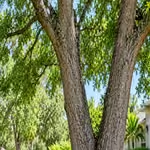
- Co-dominant Stems with Included Bark: When a tree has two main trunks in a ‘V’ shape, bark often gets trapped between them. This trapped moisture leads to rot at the most critical structural junction of the tree.
- Canker Rot: Sunken areas of bark or ‘bleeding’ sap can indicate that fungi are killing the cambium layer and moving into the heartwood.
- Abnormal Swelling: If the trunk looks ‘fat’ or swollen in one specific area, the tree may be producing ‘reaction wood’ to compensate for internal hollows.
The Hazard Equation: Defect vs. Target
In professional arboriculture, a tree is not considered a ‘hazard’ simply because it has rot. We use a formula: Hazard = Defect + Target. If a tree has 50% internal rot but is located in the middle of a 100-acre forest, it is a biological curiosity, not a hazard. However, if that same tree is 15 feet from your bedroom window, the ‘Target’ value is extremely high, and the risk becomes unacceptable. This distinction is crucial for homeowners to understand when discussing options with an arborist. We prioritize ‘Target Management.’ Sometimes, moving a target (like a swing set or a parked car) can mitigate the risk without needing to remove the tree. But when the target is a permanent structure, the structural defect must be addressed directly through technical intervention or removal.
Advanced Diagnostics: Looking Inside the Wood
When a visual inspection is inconclusive, arborists turn to ‘Level 3’ advanced assessments. These technologies allow us to look inside the tree without causing further damage. Two primary tools have revolutionized this field:
Sonic Tomography (Acoustic Imaging)
Sonic Tomography works similarly to a medical CT scan. Sensors are placed around the trunk, and sound waves are sent through the wood. Sound travels fast through dense, healthy wood and slowly through rot or air. The resulting ‘Tomogram’ is a color-coded map of the tree’s interior. A large blue or violet area in the center of the map indicates a hollow or advanced rot, providing scientific proof of the tree’s condition.
Resistograph Testing
A Resistograph is a precision instrument that drives a very fine, long needle into the wood at a constant speed. The machine measures the resistance the needle encounters. High resistance equals solid wood; a sudden drop in resistance indicates a cavity or soft, decayed tissue. This provides a microscopic look at the growth rings and the extent of the decay wall.
The Decision Framework: Treatment vs. Removal
Deciding whether to save or remove a tree involves balancing the tree’s health, its value to the landscape, and the safety of the residents. Below is a comparison of how different factors influence the final decision:
Mitigation Strategies: Can Your Tree Be Saved?
For trees with localized rot or heavy limb weight, structural pruning is the first line of defense. By thinning the ‘sail’ of the tree, we reduce the amount of wind force the trunk must endure during a storm. Additionally, supplemental support systems, specifically high-strength cables and braces, can be installed to redistribute the load from a weak point to a stronger portion of the tree. However, these systems require annual inspections. In many cases, especially with ‘Butt Rot’, where the very foundation of the tree is compromised, removal is the only responsible course of action. Removing a hazardous tree is a complex engineering task that requires specialized rigging, aerial lifts, and a deep understanding of physics to ensure the tree is dismantled safely without impacting the surrounding targets.
Frequently Asked Questions
What is internal tree rot exactly?
Internal tree rot is the biological decomposition of a tree’s internal wood (cellulose and lignin) by specialized fungi. It often leaves the outer bark looking healthy while the structural core becomes hollow or brittle.
What is the most dangerous type of rot in Florida?
In Florida, Ganoderma zonatum is a primary concern. It causes ‘ Ganoderma Root Rot,’ which targets the lower 4-5 feet of the trunk and roots of palms and hardwoods, often leading to sudden failure.
Does a rotting tree always have to be removed?
Not necessarily. If the tree has high vitality and the decay is localized, mitigation through pruning or cabling may work. However, if the ‘Hazard Tree’ equation shows a high-value target (like your home), removal is often the safest path.
Can I diagnose internal rot myself?
While a rubber mallet test can reveal large hollows, professional tools like Sonic Tomography create a visual map of the interior, and a Resistograph measures wood density with precision that human senses cannot match.
How does hurricane season affect trees with internal rot?
Heavy rain saturates the soil, reducing root anchorage. When combined with the high wind loads of a hurricane, a tree with even 30% internal decay is significantly more likely to fail than a healthy one.
Protecting Your Property Starts with Early Detection
Internal tree rot is a silent but manageable threat when identified early. By understanding the biology of decay and the specific environmental pressures of Jacksonville, you can make informed decisions that protect both your landscape and your home. If you suspect a tree on your property is suffering from hidden decay, do not wait for the next storm to provide the answer. For a definitive, technology-backed evaluation, contact Bushor’s Tree Surgeons. Our team of ISA Certified Arborists utilizes the latest diagnostic tools to provide clear, actionable risk assessments, ensuring your family’s safety and your property’s value remain intact.