April 29, 2026
Key Takeaways
- The Jacksonville Tree Ordinance (Chapter 656 Part 12) remains the primary legal framework for protecting the city’s urban canopy in 2026.
- Most protected trees require a permit for removal if they meet specific size thresholds, typically measured at Diameter at Breast Height (DBH).
- Residential exemptions exist for occupied single-family lots, but Exceptional Specimen trees often require special review regardless of location.
- 2026 updates emphasize the use of the Tree Mitigation Fund to restore the canopy in underserved Jacksonville neighborhoods.
- Fines for unauthorized removal of protected trees can be substantial, often calculated per inch of the tree’s diameter.
If you’ve lived in Jacksonville for more than a few months, you know that our trees are more than just landscaping; they are the lungs of the city. From the ancient sprawling branches of the Treaty Oak to the pine stands of Mandarin, our River City identity is rooted in its canopy. However, as Jacksonville continues to grow at a record pace in 2026, the friction between development and nature has led to some of the strictest tree-protection rules in the state of Florida.
Navigating the Jacksonville Tree Ordinance can feel like wandering through a thicket of legal jargon. Whether you are a homeowner wanting to clear space for a new pool or a developer planning a multi-unit complex, the rules have changed. In 2026, the city has doubled down on enforcement and inch-for-inch mitigation. Understanding these rules isn’t just about being a good neighbor; it’s about avoiding the heavy fines and legal headaches that come with the unauthorized removal of a protected species.
What Exactly is a Protected Tree in 2026?
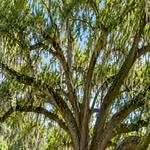
In the eyes of the City of Jacksonville, not all trees are created equal. The ordinance specifically targets Protected Trees, and the definition depends heavily on the tree’s location. Generally, a tree is protected if it is a high-quality species (like a Live Oak, Cedar, or Bald Cypress) and reaches a certain size.
As of 2026, the standard measurement used by the Building Inspection Division is the Diameter at Breast Height (DBH), which is the width of the trunk measured 4.5 feet above the ground. For most private properties, any tree with a DBH of 6 inches or more located within 20 feet of a street right-of-way or 8 inches or more within 10 feet of a property line falls under the city’s protection. If you have an Exceptional Specimen tree, usually defined as a healthy tree with a DBH of 24 inches or greater, the rules become even more stringent. These giants are considered community assets, and the city makes it very difficult to remove them without a verified safety justification.
The Residential Exemption: A Common Misconception
One of the most frequent questions we hear is: Do I really need a permit if the tree is in my own backyard? The answer is a classic Jacksonville, maybe. There is a residential exemption for occupied single-family homes on lots that cannot be further subdivided. If your home is established and you aren’t planning to split your lot to build another house, you generally have more freedom to manage your trees.
However, the 2026 updates have clarified that this exemption does not give homeowners a blank check to clear-cut their property. If the tree is deemed an Exceptional Specimen or if it was part of a previously approved landscape plan for a newer subdivision, you may still be required to obtain a permit or provide mitigation. Furthermore, if you remove a tree that is later determined to have been protected, the burden of proof is on you to show it was dead, dying, or dangerous. This is why having a documented arborist report is the best insurance policy a homeowner can have.
The Permit Process: What to Expect
If you find yourself needing a permit for tree removal in 2026, don’t expect a 24-hour turnaround. The process has become more digitized but also more thorough. You start by submitting an application through the 630-CITY CARE platform or the Building Inspection Division.
You’ll need to provide a site plan showing the location, species, and DBH of the trees in question. For trees that are being removed due to poor health, the city almost always requires a letter from an ISA Certified Arborist. They want to see that you’ve explored other options like cabling, bracing, or structural pruning before reaching for the chainsaw. Once the application is in, an Urban Forester from the city may visit your property to verify the tree’s condition. If approved, you’ll receive a permit that must be displayed on-site during the removal.
Mitigation and the Tree Fund
Jacksonville operates on a no net loss philosophy. If you remove a healthy protected tree, the city expects you to replace that canopy. This is known as mitigation. You have two main options:
- On-Site Replanting: You plant new approved species on your property. The 2026 rules emphasize native Florida trees like the Southern Magnolia or the Winged Elm.
- The Tree Mitigation Fund: If your lot is too small for new trees, you can pay a fee instead of the city’s Tree Fund. This money is then used by the Tree Commission to plant trees in public parks and right-of-ways across the city.
In 2026, the costs for the Tree Fund have been adjusted to reflect the rising price of nursery stock and labor. Paying into the fund is often the quickest path for developers, but for a residential homeowner, it can be a significant, unexpected expense.
Why 2026 is Different: Increased Enforcement
If you’re thinking about sneaking a removal over the weekend, think again. In 2026, Jacksonville has increased its use of satellite imagery and aerial canopy mapping to track changes in the urban forest. Code enforcement officers are more active than ever, and they often respond to tips from neighbors who are aware of the strict local laws.
The fines for illegal removal are designed to be punitive. In some cases, you may be fined double or triple the standard mitigation fee plus the cost of replanting. For a large Live Oak, those costs can easily climb into the tens of thousands of dollars. It is always cheaper and less stressful to go through the proper channels from the start.
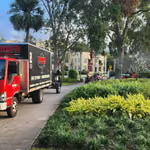
Navigating the 2026 Jacksonville Tree Ordinance is a lot easier with a partner who has been doing this since 1962. Bushor’s Tree Surgeons was founded by Eugene L. Bushor and carried on by three generations of ISA Certified Arborists. We offer flat-rate pricing and no hidden fees for a full suite of services. Whether you need safe tree removal, tree trimming and pruning, or 24/7 emergency tree services following a storm, our team is ready to help across Duval, St. Johns, Clay, and Nassau counties. We also provide specialized tree health care, tree cabling and bracing to help stabilize valuable trees, and stump removal or grinding to clean up your landscape. From the core of Jacksonville to Ponte Vedra Beach and Orange Park, Bushor’s Tree Surgeons bring modern equipment and decades of experience to every job. Trust the experts with an A+ BBB rating to handle your permit documentation and arborist-led tree care today.
Frequently Asked Questions
1. Does the Jacksonville Tree Ordinance apply to dead trees?
Yes and no. While you are generally allowed to remove a dead or imminently dangerous tree, the city still requires you to notify them or obtain a no-fee permit in many cases. You should always have photo evidence or an arborist’s report proving the tree was dead before it was cut down.
2. How is the DBH calculated for a multi-trunk tree in Jacksonville, FL?
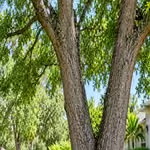
For trees with multiple trunks, the DBH is usually calculated by taking the diameter of the largest trunk and adding half of the diameter of the remaining trunks. This can get complicated, so it’s best to let a pro measure it.
3. What happens if a protected tree falls during a storm in Jacksonville, FL?
During a declared state of emergency (like a hurricane), the city often waives permit requirements for trees that have already fallen or are blocking access. However, you should still document the damage thoroughly before the debris is hauled away.
4. Are pine trees protected in Jacksonville, FL?
Yes, certain species like the Longleaf Pine are protected. However, smaller pines or those located far from the property lines may have different requirements than Shade Trees like Oaks.
5. Can a Homeowners Association (HOA) have stricter rules than the City?
Absolutely. An HOA can have its own set of bylaws that are more restrictive than the city ordinance. You must comply with both. The city permit does not override your HOA’s authority.
6. What is the 630-CITY tree planting program in Jacksonville, FL?
It is a city-run program where homeowners can request up to two trees to be planted in the city-owned right-of-way in front of their house for free. It’s a great way to add value to your property at no cost.
7. Is a permit required for pruning in Jacksonville, FL?
Generally, no, as long as you are following ANSI A300 pruning standards. However, topping a tree or removing more than 25% of the live canopy can be considered effective removal and may trigger a fine.
8. How much does a tree removal permit cost in Jacksonville, FL?
For residential exemptions, the application fee is typically around $25. For commercial projects or large-scale clearing, the fees scale based on the size and number of trees being impacted.
Summary Checklist: Navigating the 2026 Ordinance
| Condition | Risk Level | Recommended Action |
|---|---|---|
| Tree over 6″ DBH near public street | Protected | Review local permit requirements before pruning or removal work begins |
| Specimen tree over 24″ DBH | High | An ISA arborist report may be required before removal approval is granted |
| Dead or hazardous tree | Lower risk if documented | Document the condition with photos and arrange a professional hazard assessment |
| New construction or lot clearing | High | Submit required tree inventory documents and landscape plans before site work |
| Pruning over 25% of canopy | Moderate | Ensure pruning follows accepted arboriculture standards to avoid violations |
Final Advice
The logic of tree safety in 2026 is about being proactive rather than reactive because the worst time to learn about the Jacksonville Tree Ordinance is after you have already received a citation. Most homeowners don’t realize that the city’s rules are in place not to be a nuisance but to protect the property values and environmental health of our entire community. A single mature oak can provide thousands of dollars in cooling costs and stormwater management over its lifetime.
If you are unsure about the status of a tree on your property, trust your gut and get a professional opinion. An ISA Certified Arborist can often help you navigate the permit process or even suggest ways to save a tree that you thought had to go. Don’t leave your property’s legal standing to chance.
For expert guidance in the Jacksonville area, call Bushor’s Tree Surgeons at (904) 789-8884 to ensure your trees are handled legally and safely.