5525 St. Augustine Rd, Jacksonville,
FL 32207

Open 24/7

Large tree with saturated soil and root instability during heavy rain and high wind storm conditions near residential property, showing early tree failure risk

When the sky darkens, and the wind begins to howl across the rolling hills of Middle Tennessee, homeowners often look toward their towering oaks, maples, and hackberries with a mixture of awe and anxiety. A single mature tree can weigh several tons, and its failure during a storm is not merely a landscaping inconvenience; it is a catastrophic event that can compromise the structural integrity of a home or threaten lives. Understanding tree failure requires moving beyond simple observations and into the realms of biomechanics, soil science, and structural engineering. By identifying the intersection of local geology, tree biology, and meteorological forces, property owners can move from reactive fear to proactive management. This guide explores the scientific reasons trees fail and the advanced arboricultural methods used to prevent these failures before the next storm front arrives.

Key Takeaways

  • Tree failure is often the result of pre-existing structural defects exacerbated by environmental triggers like windload and soil saturation.
  • Middle Tennessee’s unique geological profile, featuring shallow limestone and heavy clay, creates specific risks for lateral root instability.
  • The ‘Sail Effect’ is a measurable mechanical force that can be mitigated through scientific canopy thinning.
  • Internal decay is often invisible to the naked eye but can be detected through advanced diagnostic tools like sonic tomography.
  • Professional risk assessment (TRAQ) quantifies the probability of failure, allowing for prioritized safety investments.
  • Proactive maintenance is statistically more cost-effective than emergency storm response and insurance claims.

The Biomechanics of Tree Failure

Tree failure is rarely a spontaneous event; it is the culmination of structural weaknesses meeting extreme environmental loads. In arboriculture, we categorize failure into two primary types: structural breakage (windsnap) and uprooting (windthrow). To understand these, we must look at the tree as a cantilevered beam anchored in a semi-solid medium. The canopy acts as the ‘lever arm,’ the trunk as the ‘beam,’ and the root system as the ‘anchor.’ During high winds, the force applied to the canopy creates a massive amount of torque at the base. If the wood’s tensile strength is compromised by decay, or if the soil’s shear strength is weakened by moisture, the system fails. According to research from Purdue University Extension, many trees that fail during storms already had internal defects that reduced their structural capacity by 30% or more before the wind even started blowing.

The Local Factor: Middle Tennessee Geology and Tree Stability

For residents in regions like Nashville and surrounding Middle Tennessee counties, the risk of tree failure is uniquely tied to the ground beneath their feet. The region is defined by its ‘Karst’ topography, a landscape shaped by the dissolution of soluble rocks, primarily limestone. This leads to several critical issues for tree stability.

Shallow Bedrock and Lateral Root Constraints

In many parts of the region, the distance from the grass to the solid limestone bedrock is surprisingly shallow, often only 12 to 36 inches. Trees like the Bur Oak or Shagbark Hickory, which might naturally prefer deep taproots, are forced to grow massive lateral root systems instead. While these lateral ‘pancake’ roots provide stability in dry conditions, they lack the deep vertical anchoring needed when top-heavy canopies are caught in high-velocity wind gusts.

The Lubrication Effect of Saturated Clay

The ‘Nashville Clay’ is notorious among builders and arborists alike. Clay is a fine-textured soil that holds water with high tenacity. During heavy rain, these clay particles become lubricated. The soil loses its ‘cohesion,’ meaning it no longer grips the roots effectively. When a tree leans during a wind gust, the roots on the windward side are pulled upward. In dry soil, friction holds them; in saturated clay, they simply slide out of the ground. This phenomenon, often called ‘root plate failure,’ is the leading cause of large-scale tree falls in the Southeast.

Identifying Hazard Trees: The Homeowner’s Checklist

Homeowners are the first line of defense in identifying hazard trees. A professional inspection is necessary for a final verdict, but several ‘red flags’ indicate a tree is reaching its breaking point. Ignoring these signs is the most common precursor to property damage.

  • Abrupt Leaning: A tree that has always leaned is less concerning than one that has developed a new lean or has disturbed soil at its base after a storm.
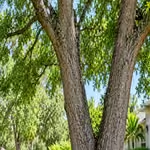
  • Codominant Stems with Included Bark: When a tree has two main trunks of equal size, the point where they meet is often weak. If you see bark growing inward between the stems, it acts like a wedge, slowly pushing the trunks apart until one snaps during high winds.
  • Cankers and Conks: Mushrooms growing at the base or on the trunk are the ‘fruiting bodies’ of internal fungi. If you see these, the inside of your tree is likely being digested by rot, even if the leaves look green.
  • The ‘Widowmaker’ Phenomenon: Large, dead branches hanging in the upper canopy. These are the first things to fall during moderate winds and represent a significant life-safety hazard.
  • V-Shaped Unions: Branch attachments that form a tight ‘V’ are significantly weaker than those that form a ‘U’ shape, as they lack the ‘branch bark ridge’ that provides structural reinforcement.

Advanced Diagnostics: The Science of Risk Assessment

Modern arboriculture has moved beyond simple visual inspections. To provide a truly accurate risk assessment, professionals use technology that allows them to ‘see’ inside the tree without harming it. This is essential for high-value trees near homes or power lines.

Sonic Tomography and Resistance Drilling

Sonic tomography is the gold standard for non-invasive testing. By placing sensors around the circumference of the trunk and sending sound waves through the wood, arborists can create a color-coded ‘map’ of the tree’s interior. Sound travels faster through solid, healthy wood and slower through hollow or decayed areas. This allows for a precise calculation of how much ‘holding wood’ remains to support the tree’s weight.

The TRAQ Matrix: Quantifying Danger

The Tree Risk Assessment Qualification (TRAQ) is a standardized method developed by the International Society of Arboriculture (ISA). It moves away from subjective ‘guesses’ and toward a matrix that evaluates the likelihood of a tree failing, the likelihood of it hitting a ‘target’ (like a house), and the severity of the resulting damage. This data-driven approach helps homeowners prioritize which trees need immediate attention and which can be monitored.

Proactive Engineering: Strategies for Storm Resistance

Prevention is an engineering challenge. By modifying the tree’s structure and its environment, we can significantly increase its ‘Critical Wind Speed’, the point at which it is likely to fail.

Structural Pruning and the Sail Effect

Traditional ‘topping’ is a destructive practice that actually increases storm risk by creating weak regrowth. Proper structural pruning involves ‘thinning’, the selective removal of small branches to reduce the wind’s drag on the canopy. By reducing the ‘sail area’ of the tree, we allow wind to flow through the branches, drastically reducing the torque applied to the root system. This is a practice often detailed in USDA Forest Service guidelines for urban forest management.

Cabling, Bracing, and Supplemental Support

For trees with codominant stems or heavy, overextended limbs, supplemental support systems are an excellent alternative to removal. High-strength steel cables or dynamic rope systems are installed in the upper third of the canopy to limit the movement of limbs during storms. This allows the branches to move together as a unit, preventing the ‘snapping’ action that occurs when limbs oscillate at different frequencies.

Soil Health and Root Zone Protection

Because root anchorage is the primary failure point in Middle Tennessee, managing the ‘Critical Root Zone’ is vital. This involves preventing soil compaction from vehicles, avoiding trenching for utilities near the tree, and using organic mulch to maintain proper soil moisture levels, which prevents the ‘shrink-swell’ cycle of clay that can snap fine feeder roots.

The Economics of Trees: Proactive Care vs Emergency Response

Many homeowners hesitate to invest in proactive tree care, viewing it as an optional expense. However, a financial analysis of storm damage reveals that prevention is almost always the more economical choice. When a tree fails, the costs extend far beyond the removal of the debris.

Action Type Hidden or Secondary Costs Risk Level
Proactive Pruning or Inspection Minimal, can improve property value Low, controlled conditions
Emergency Storm Removal Over time, labor costs, crane costs, and urgent scheduling fees Very high, active safety risk
Property Damage Repair Insurance deductibles, repairs, and temporary housing Severe, immediate hazard
Loss of a Mature Tree Reduced shade, higher cooling costs, lower property value Long-term financial impact

Frequently Asked Questions

Why are trees in Middle Tennessee particularly prone to falling?

Middle Tennessee is dominated by heavy clay soils and shallow limestone bedrock. Clay expands significantly when wet, losing its shear strength, while the shallow bedrock prevents deep taproots, forcing trees to rely on lateral root systems that are more susceptible to uprooting during saturation.

How does heavy rain lead to tree uprooting?

Saturation reduces the friction between the roots and the soil particles. In Nashville’s clay-rich environment, water acts as a lubricant. When combined with wind-induced leverage, the root plate can no longer resist the lateral forces, leading to ‘windthrow’ or total uprooting.

Can pruning really prevent a tree from falling?

Strategic thinning, or crown thinning, reduces the ‘drag coefficient’ of the tree. By allowing wind to pass through the canopy rather than pushing against it like a solid sail, the force transferred to the trunk and roots is reduced by as much as 30-50%.

What are the most urgent warning signs of tree failure?

Look for ‘heaving’ soil at the base, which looks like the ground is lifting. Other signs include fresh cracks in the trunk, the sudden appearance of mushrooms (fungal conks) which indicate internal rot, and deadwood in the upper canopy known as ‘widowmakers.’

Protecting Your Property Starts With Understanding Tree Structural Risk

The structural integrity of your landscape is a long-term investment that requires scientific understanding and professional oversight. While nature is unpredictable, the application of modern arboricultural techniques can significantly tip the scales in favor of safety and property preservation. For homeowners seeking to secure their properties against the unique meteorological and geological challenges of the region, Bushor’s Tree Surgeons provides the technical expertise and certified risk assessments necessary to navigate storm seasons with confidence.

Testimonials

What Our Clients Say

Quote

Shannon R.

Bushor’s Tree Surgeons Client

Google star

“This is THE best tree company in Jacksonville. They were willing to work around my schedule, they were efficient, knowledgeable, and affordable ... Their work exceeded my expectations and I can easily say that they were worth every penny for the amazing job they did.”

Quote

Dawn D.K.

Bushor’s Tree Surgeons Client

Google star

“Absolutely in awe! My husband and I could not be more pleased with the service we received. Bushor's Tree Surgeons are the cream of the crop. They arrived before 8am (outstanding) and completed the cutting, debris removal and cleaning of four huge pines before 4pm ... Thanks a million. Beautiful job.”

Quote

Nancy B.

Bushor’s Tree Surgeons Client

Google star

“Bushor's Tree Surgeons employs the best crew. We had the pleasure of seeing their work first hand. Additionally, the equipment used is first rate. There are 3 certified arborists on staff. Their knowledge is invaluable. Great company with equally great people.”

Quote

Bowman AC

Bushor’s Tree Surgeons Client

Google star

“Our experience with Bushor's was excellent! From scheduling the estimate, competitive pricing to clean up. The whole staff was very professional and pleasant to work with ... Bushor's is a top-notch company!”

Quote

Sara D.

Bushor’s Tree Surgeons Client

Google star

“I highly recommend Bushor's Tree Surgeons. They take pride in the work they do and it shows. We used them to remove trees, trim trees and cable a tree. They did such great work. The team was professional and friendly. Such a pleasure to work with. Their pricing is fair and competitive.”

Quote

Edward G.

Bushor’s Tree Surgeons Client

Google star

“EXTREMELY professional and pleasant to work with. They showed up exactly when they said they would, protected as many things as possible, including the lawn, before they commenced work, and completely cleaned up when they were done ... I would highly recommend Bushor's Tree Surgeons to anyone!”

You Can Trust The
Experts At Bushor’s
Tree Surgeons

Schedule Your Free Estimate Today!

Trust our expert arborists to rejuvenate your space. Schedule now and let nature flourish safely around you.

Request a Free Estimate

Fill out the form below, and we'll get back to you.