April 30, 2026
Living in Northeast Florida means we are well-acquainted with the power of a Nor’easter. Unlike a fast-moving tropical thunderstorm, these coastal storms linger for days and batter our trees with relentless wind and soaking rain. By the time the wind starts gusting to forty miles per hour, it is too late to wonder if your trees are up for the challenge. The real work happens in the quiet weeks before the clouds roll in. To the untrained eye, a tree might look perfectly fine during a sunny afternoon, but a professional knows that trees are living organisms that communicate their health through their leaves, bark, and root zones. If you know what to look for, you can find the weak spots that a Nor’easter will surely exploit. Identifying these issues early doesn’t just save your tree, but it also protects your roof, your vehicles, and your family from the unpredictable nature of falling timber.
Stress in a tree isn’t just a feeling, but it is a physiological state where the tree is spending more energy on survival than on growth. In Jacksonville, this often happens due to our sandy soil and fluctuating water table, or even damage from old construction. When a tree is stressed, its wood becomes more brittle, and its root system loses its ability to anchor the weight of the canopy. This is a critical distinction because a healthy tree is designed to be flexible. The cellulose and lignin in the wood fibers act like a natural shock absorber. However, when a tree is under chronic stress from drought, disease, or poor soil nutrition, those fibers lose their elasticity.
A stressed tree is a prime target for storm failure. While a healthy Live Oak can flex and sway with the wind, a stressed tree might snap because its fibers have lost their give. Understanding the difference between a tree that is dormant and one that is dying is the first step in storm preparation. In the Jacksonville area, we see many trees that appear green on the outside but are structurally hollow or decayed on the inside. This is why visual inspections of the bark and trunk are so vital. If the tree cannot support its own weight during a calm day, it certainly cannot withstand the lateral force of a three-day Nor’easter.
The highest point of your tree is often the first place to show signs of trouble. If you notice that the very top branches, the crown, look thin or bare while the rest of the tree is green, you are looking at crown dieback. This is a clear signal that the tree is struggling to push nutrients and water all the way to its furthest points. This is often caused by root rot or soil compaction, which is a common issue in developing Jacksonville neighborhoods where heavy machinery has packed down the earth around old oaks.
During a Nor’easter, these dead or weakened branches act like sails. Because they are brittle, they don’t flex with the wind, and instead, they snap and become dangerous projectiles. If you see bare wood at the top of your oaks or maples, it is time to have a professional evaluate the overall health of the tree before the wind picks up. Furthermore, a thinning canopy allows more wind to penetrate the tree. A healthy, dense canopy actually works together to baffle the wind, but a thin canopy allows the wind to strike the main branches with full force, increasing the risk of a catastrophic split.
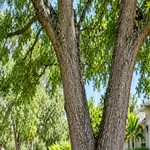
One of the most common structural weak spots we see in Jacksonville is the V-shaped union. This happens when two main trunks grow from the same point. Over time, as the trunks get larger, they push against each other, and bark gets trapped in the middle. This is called included bark. Unlike a strong U-shaped union, which is fused wood, a V-shaped union is essentially a pre-made crack. When a Nor’easter hits, it pushes these two trunks in opposite directions. Because they aren’t actually grown together, the tree can split right down the middle like a piece of firewood.
If you see a tight V-junction with a seam of bark tucked inside, you have a major weak spot that needs cabling or removal. These unions are particularly dangerous during Nor’easters because the wind is often multi-directional. As the wind swirls, it creates a twisting motion on the tree known as torque. A V-shaped union has almost zero resistance to twisting forces. This is why we often see large sections of otherwise healthy trees lying on the ground after a storm. The wood itself was strong, but the connection point was fundamentally flawed. Structural pruning at a young age can prevent this, but for mature trees, professional cabling is the best way to secure the union.
To effectively spot weak spots, you must perform a 360-degree walkaround of every large tree on your property.
Identifying these red flags early allows you to take corrective action, like cabling or pruning, before the coastal winds arrive.
The most dangerous weak spots are the ones you can’t see because they are underground. However, the tree gives us clues at the base of the trunk. If you see mushrooms or fungal conks growing out of the roots or the lower bark, you are looking at internal decay. Fungus feeds on dead or rotting wood. If it is visible on the outside, it means the inside of the tree is likely turning to mush. This is a critical indicator of root rot, which is exacerbated by Jacksonville’s high humidity and frequent heavy rains.
Another sign to watch for is soil heaving. If you see a gap between the trunk and the grass or if the soil looks like it is lifting on one side, your tree is already losing its grip. In the saturated conditions of a Nor’easter, this loose anchor will eventually fail. Jacksonville’s sandy soil doesn’t provide much help once it becomes waterlogged, so a strong root system is your only defense. When the ground becomes a slurry, the root plate needs to be wide and deep to keep the tree upright. If the roots are decayed or the soil is shifting, the tree becomes a giant lever just waiting for a gust to pull it over.
When the forecast calls for a Nor’easter, you need the peace of mind that comes with a professional inspection, and since 1962, Bushor’s Tree Surgeons has helped Jacksonville homeowners identify and fix tree weak spots before they become emergencies. As a third-generation family business led by ISA Certified Arborists, we understand the specific challenges of Northeast Florida’s climate and soil, and we offer everything from structural pruning and cabling to safe removals and 24/7 emergency service. We don’t just look at the leaves, but we analyze the structural integrity of the entire organism to ensure it can withstand the unique pressures of coastal weather. Bushor’s Tree Surgeons offer a full range of services, including tree trimming, safe tree removal, stump grinding, tree health care, and structural support systems like cabling and bracing.
Don’t wait for a storm to tell you your tree is stressed and call us at (904) 789-8884 for a free flat-rate estimate and let three generations of expertise protect your landscape.
Nor’easters bring sustained winds and high rainfall over several days. This saturates the soil and puts constant stress on the wood fibers, whereas a typical thunderstorm is over in an hour.
Some stress factors, like dehydration, can be fixed quickly, but structural weak spots or deep decay often require professional intervention, like pruning or removal, to ensure safety.
It looks like a deep crease or a seam where two branches meet in a tight V-shape. If you see a line of bark that seems to be folding inward rather than a smooth wood bridge, it is likely included bark.
While some oaks are deciduous, many in Florida, like Live Oaks, are nearly evergreen. If your tree is dropping large amounts of green leaves suddenly, it is a sign of acute stress.
Any fungal growth on the trunk or roots is a sign of decay. While not all mushrooms mean the tree will fall today, they all indicate that the wood is being compromised internally.
Yes. Proper thinning allows the wind to pass through the canopy rather than pushing against it like a sail. This reduces the leverage force on the trunk and roots.
Many trees grow at an angle toward the sun. A natural lean is usually fine, but a new lean or a lean where the ground is lifting is a critical emergency.
Vertical cracks that go deep into the wood are serious structural failures. You should keep people and property away from the fall zone and call an arborist immediately.
| Risk Factor | Why It Matters | What Homeowners Should Do |
|---|---|---|
| Crown dieback | Dead or brittle upper branches catch wind easily and are more likely to snap during storms | Schedule deadwood removal to reduce wind resistance and storm risk |
| V-shaped branch unions | Included bark creates structural weak points that can split under heavy wind pressure | Have an arborist assess whether cabling or bracing is needed for support |
| Mushrooms at the base | Fungal growth often signals internal decay, root rot, or weakened structural stability | Arrange a professional arborist evaluation of root and trunk condition |
| Soil gaps or ground heaving | Movement in the soil may indicate root plate failure or shifting tree stability | Stay clear of the potential fall zone and request immediate stability assessment |
| Sudden leaf drop | Stress from drought, pests, or disease can weaken tree flexibility before severe weather | Investigate watering issues, pest activity, or health decline with professional guidance |
The logic of tree safety is about being proactive rather than reactive because the worst time to find a weak spot is in the middle of a Nor’easter. Most tree failures are the result of long-term stress that was simply ignored until the wind provided the breaking point. By taking the time to walk your property and look for signs of dieback, trunk cracks, or fungal growth, you are taking a massive step in protecting your home. A healthy tree is an asset, but a stressed tree is a liability that only gets more dangerous as the weather worsens. In Jacksonville, our trees deal with everything from salt spray to extreme heat, so they are already working hard to stay healthy. Adding the pressure of a coastal storm to a tree that is already struggling is a recipe for disaster.
If you see something that doesn’t look right, trust your gut and get a professional opinion. An ISA Certified Arborist can often save a stressed tree through specialized fertilization or strategic pruning if the issues are caught early enough. Don’t leave your property’s safety to chance during storm season. The weight of a fallen oak can be tens of thousands of pounds, and the damage it causes is often far more expensive than a preventive inspection. Call the experts at Bushor’s Tree Surgeons at (904) 789-8884 to ensure your trees are ready to stand tall through the next Nor’easter.
What Our Clients Say

Shannon R.
Bushor’s Tree Surgeons Client
“This is THE best tree company in Jacksonville. They were willing to work around my schedule, they were efficient, knowledgeable, and affordable ... Their work exceeded my expectations and I can easily say that they were worth every penny for the amazing job they did.”

Dawn D.K.
Bushor’s Tree Surgeons Client
“Absolutely in awe! My husband and I could not be more pleased with the service we received. Bushor's Tree Surgeons are the cream of the crop. They arrived before 8am (outstanding) and completed the cutting, debris removal and cleaning of four huge pines before 4pm ... Thanks a million. Beautiful job.”

Nancy B.
Bushor’s Tree Surgeons Client
“Bushor's Tree Surgeons employs the best crew. We had the pleasure of seeing their work first hand. Additionally, the equipment used is first rate. There are 3 certified arborists on staff. Their knowledge is invaluable. Great company with equally great people.”

Bowman AC
Bushor’s Tree Surgeons Client
“Our experience with Bushor's was excellent! From scheduling the estimate, competitive pricing to clean up. The whole staff was very professional and pleasant to work with ... Bushor's is a top-notch company!”

Sara D.
Bushor’s Tree Surgeons Client
“I highly recommend Bushor's Tree Surgeons. They take pride in the work they do and it shows. We used them to remove trees, trim trees and cable a tree. They did such great work. The team was professional and friendly. Such a pleasure to work with. Their pricing is fair and competitive.”

Edward G.
Bushor’s Tree Surgeons Client
“EXTREMELY professional and pleasant to work with. They showed up exactly when they said they would, protected as many things as possible, including the lawn, before they commenced work, and completely cleaned up when they were done ... I would highly recommend Bushor's Tree Surgeons to anyone!”
Trust our expert arborists to rejuvenate your space. Schedule now and let nature flourish safely around you.
Fill out the form below, and we'll get back to you.