August 13, 2026
Key Takeaways
- Not all trees handle hurricane-force winds the same way; species selection matters as much as maintenance.
- Deep, wide root systems and flexible wood generally hold up better than shallow roots and brittle branches.
- Southern live oaks, bald cypress, and sabal palms are among the most reliably storm-resistant species here.
- Some popular ornamentals are actually high-risk during storms.
- Proper spacing, pruning, and soil conditions significantly improve any tree’s storm performance.
- Even storm-resistant species need regular maintenance to reach their full wind tolerance.
Every hurricane season, Jacksonville homeowners ask which trees will actually survive the next big storm. The answer has a lot to do with what gets planted and how it’s maintained long before a storm arrives. Some species have evolved with flexible wood and deep root systems that let them bend and hold ground. Others have brittle limbs, shallow roots, or top-heavy canopies that snap or uproot in high winds. This isn’t just an academic exercise, either. Bushor’s Tree Surgeons spent the weeks after every major storm walking properties across Jacksonville, Ponte Vedra, and the surrounding counties, and the pattern is remarkably consistent. Certain species show up on our cleanup jobs storm after storm, while others, planted in the same neighborhoods and exposed to the same wind and rain, are still standing without a scratch. That real-world track record is the best evidence we have for what actually performs well here.
Here’s our list of the most storm-resistant trees for Northeast Florida, and what makes each one durable.
1. Southern Live Oak
Southern Live oaks define resilience in this region. They have an extraordinarily deep, wide root system, dense wood, and a naturally low, spreading canopy that reduces wind resistance. They’re famous for surviving hurricanes that take down weaker species around them, and some of the oldest, most storied trees in Jacksonville neighborhoods like Ortega and Avondale are live oaks that have weathered dozens of storms over the past century. They’re not invincible, though. Poor pruning history, included bark at major limb unions, or compacted root zones can still cause failure even in an otherwise healthy specimen. That’s part of why regular structural pruning by a certified arborist matters so much for this species specifically. A live oak that’s been correctly pruned throughout its life tends to develop a much stronger, more wind-tolerant structure than one that’s been left to grow unmanaged for decades.
2. Bald Cypress
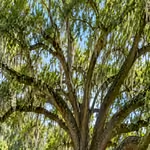
Built for wet, unstable ground, bald cypress has a buttressed trunk base and wide, shallow root flare that provide excellent stability. Its flexible branches bend rather than snap in high winds, and it tolerates standing water far better than most species, making it a strong choice near creeks, ponds, or drainage areas.
3. Sabal Palm
Florida’s state tree has a flexible trunk that bends significantly in high winds without breaking, and a fibrous root system that spreads widely and holds well in sandy soil. Its fronds shed in strong wind rather than catching it like a sail, so while individual fronds may break, the trunk rarely fails.
4. Southern Magnolia
Southern Magnolias have a strong central trunk and wood that’s more flexible than many assume. Their dense evergreen canopy catches more wind, but structural strength generally compensates. They perform best with consistent structural pruning; trees allowed to grow multiple co-dominant leaders are more prone to splitting.
5. American Holly
American holly is well adapted to Northeast Florida’s sandy coastal soils and performs reliably in both residential landscapes and natural settings. Its deep green foliage, strong branching structure, and tolerance for occasional salt exposure make it a durable choice for Ponte Vedra and Jacksonville Beach properties. Once established, it requires relatively little maintenance and is less prone to many of the moisture-related problems that affect less suitable species.
6. Red Maple
A reasonably strong wood structure and balanced canopy shape make red maple a solid middle performer, especially when it’s not planted too close to structures where root space gets restricted.
7. Winged Elm
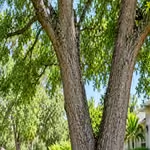
Winged elm is a hardy native tree that adapts well to Jacksonville’s sandy soils and changing weather conditions. It develops a strong branching structure, tolerates periods of drought, and is more wind-resistant than many fast-growing shade trees. Its adaptability and relatively low maintenance needs make it an excellent choice for homeowners seeking a resilient, long-lasting landscape tree.
Trees That Often Struggle in Storms
- Water Oaks & Laurel Oaks: These fast-growing trees often develop weaker wood and internal decay as they age. Much of this decay remains hidden until a large limb breaks or the tree fails during a storm.
- Bradford Pears: Bradford pears are known for their weak branch structure and narrow branch unions. These weak attachment points frequently split under strong winds, even in relatively young trees.
- Ornamental Palms: Compared to sabal palms, many ornamental palms have shallower root systems. This makes them more susceptible to uprooting when heavy rains saturate the soil during storms.
- Eucalyptus: Although eucalyptus grows quickly, it produces brittle wood and develops relatively shallow roots. This combination often leads to broken limbs or uprooted trees following severe weather.
None of this means these species can’t be part of a landscape. It just means they typically need closer monitoring, more frequent pruning, and realistic expectations about how they’ll perform compared to a live oak or bald cypress. If you already have one of these trees on your property, an annual health check before storm season is especially worthwhile.
What Actually Makes a Tree Storm-Resistant
Root system health and depth matter more than species alone; compacted soil or restricted root zones reduce anchorage regardless of species, which is why a live oak growing in poor, compacted soil can still be at meaningfully higher risk than one with a healthy, unrestricted root zone.
- Structural pruning history that eliminates weak, included bark unions reduces splitting risk substantially, since included bark, where two limbs grow so closely together that bark gets trapped between them instead of forming a strong wood union, is one of the most common failure points we see after storms regardless of species.
- Canopy density affects how much wind resistance a tree creates, and a canopy that’s grown dense and unmanaged over many years will generally catch more wind than one that’s been periodically thinned to let air move through it.
- Overall tree health determines whether even a naturally storm-resistant species can withstand severe weather, since a live oak dealing with disease, pest pressure, or root stress has meaningfully less reserve capacity to handle the additional load of high winds.
- Placement and spacing near structures or other trees also affects root development and failure risk, particularly when trees are planted too close together and end up competing for the same limited root space.
Scheduling a pre-season inspection with a certified & experienced tree service firm in Northeast Florida can make a lot of difference. Bushor’s Tree Surgeons can help identify weak limbs, hidden cavities, internal decay, and other structural issues before hurricane season arrives. Backed by 62 years of experience, our ISA-Certified Arborists and advanced diagnostic tools can perform thorough tree risk assessments, precision trimming & pruning, and customized tree health plans to improve storm resilience. When appropriate, Bushor’s Tree Surgeons also install professional cabling and bracing systems to support trees with included bark or co-dominant stems, helping preserve healthy trees that might otherwise fail during severe weather. Our arborist avoids last-minute topping or excessive pruning before a storm, as improper cuts can weaken a tree’s structure and increase the likelihood of storm damage instead of reducing it. Call our team at (904) 789-8884 to schedule an inspection of your trees with our arborists.
Frequently Asked Questions About Storm-Resistant Trees by Homeowners in Northeast Florida
What is the most storm-resistant tree for Jacksonville yards?
Southern live oak, thanks to its deep root system and dense, flexible wood, especially with consistent structural pruning.
Are palm trees more storm-resistant than hardwood trees?
It depends on the species. Sabal palms handle wind exceptionally well; queen palms are more vulnerable, particularly in saturated soil.
Can a storm-resistant tree still fail in a hurricane?
Yes. Species selection reduces risk, but root health, pruning history, and overall condition play a major role.
Should I remove trees that aren’t considered storm-resistant?
Not necessarily. Many can still be safely maintained with regular pruning and monitoring.
How often should trees be inspected before hurricane season?
Annually, each spring, ahead of peak hurricane season, especially for mature trees near homes or power lines.
Does planting several storm-resistant species together improve overall yard safety?
It can, particularly when species are spaced properly to avoid root competition. A mix of deep-rooted and wide-rooted species, like pairing a live oak with a bald cypress in a low-lying area, often provides more consistent resilience across a whole property than relying on a single species type.
Summary Checklist: Storm and Wind Preparation
| Step | Key Consideration | Action Item |
| Species Selection | Choose trees with strong wind tolerance. | Prioritize live oak, bald cypress, and sabal palm for new plantings. |
| Root Health | Support deep, stable root development. | Avoid compacting soil near root zones. |
| Structural Pruning | Correct weak growth patterns early. | Schedule pruning to remove co-dominant stems and included bark. |
| Canopy Management | Reduce wind resistance. | Thin dense canopies and remove deadwood before storm season. |
| Placement Planning | Reduce risk to structures. | Plant trees with adequate distance from homes and power lines. |
| Seasonal Inspection | Catch issues before storms hit. | Schedule a professional inspection each spring. |
Final Advice
Storm resistance isn’t just about picking the right species, though that’s a strong start. It’s about pairing the right tree with proper root conditions, ongoing structural care, and realistic placement. A well-chosen, well-maintained storm-resistant trees such as – live oak or bald cypress can stand through decades of Florida storms, while a poorly maintained tree of any species can become a liability in one bad season. Call Bushor’s Tree Surgeons today at (904) 789-8884 for a free estimate and storm-readiness evaluation anywhere in Duval, St. Johns, Clay, or Nassau County.