
November 16, 2026
Spanish moss is a familiar sight across Jacksonville, Florida, where its long, gray-green strands hang from live oaks, bald cypress trees, and other landscape plants. Although its appearance can concern homeowners, Spanish moss generally does not harm healthy trees. It is an epiphyte, meaning it uses trees for physical support rather than taking nutrients from them.
However, dense growth can sometimes shade a tree’s foliage, make existing structural defects harder to see, or add weight to already weakened branches. These effects are more concerning when a tree is already declining or has suffered storm damage.
Understanding the difference between harmless Spanish moss and an underlying tree health problem helps homeowners make informed decisions. In many cases, removal is unnecessary. When the growth creates a specific concern, a professional arborist can assess the tree and recommend appropriate care.
What Exactly Is Spanish Moss?
Spanish moss (Tillandsia usneoides) is a flowering plant in the bromeliad family, which also includes pineapples. Despite its common name, it is not a true moss.
Spanish moss is an epiphyte, or air plant. It grows on trees and other surfaces for support but obtains the moisture and nutrients it needs from the atmosphere, rainwater, and surrounding organic material.
Unlike parasitic plants, Spanish moss does not penetrate a host tree’s tissues to draw out sap or nutrients. Its slender stems wrap around branches, allowing the plant to hang from the canopy.
Several characteristics help Spanish moss thrive in Northeast Florida:
- Humidity and moisture: Its specialized leaf scales collect water and dissolved nutrients from rain and the air.
- Sunlight: Like other green plants, Spanish moss uses sunlight to support photosynthesis.
- Suitable surfaces: Tree branches provide a structure on which its stems can anchor.
- Adaptability: Spanish moss can tolerate dry periods by retaining moisture and becoming less active until conditions improve.
You will commonly see it hanging from live oaks and cypress trees throughout Jacksonville. It can also grow on other tree species, fences, and utility structures.
The University of Florida IFAS Extension explains that Spanish moss and similar epiphytes are generally harmless to their host plants. Their presence alone is not evidence that a tree is unhealthy.
Does Spanish Moss Kill Trees in Jacksonville, FL?
No. Spanish moss does not directly kill trees because it is not a parasite. It uses branches for support and obtains the resources it needs from its surroundings.
A healthy tree can generally tolerate Spanish moss without significant harm. However, a heavy covering may create problems in certain circumstances, particularly when the host tree is already weak or losing foliage.
Here are a few important points for Jacksonville homeowners:
- Moss does not steal nutrients from the tree. Spanish moss gathers moisture and nutrients from the air and rainwater rather than extracting them from the host tree.
- Heavy growth can shade foliage. Dense accumulations may reduce the amount of sunlight reaching some leaves, particularly on a tree that is already declining.
- Moss may reveal an existing problem. Spanish moss can become more noticeable as a tree loses foliage and more light reaches its branches.
- Existing branch defects still matter. A weak, cracked, or decaying branch may require attention whether or not Spanish moss is present.
Homeowners sometimes assume that Spanish moss caused a tree to decline because the two appear together. In many cases, the relationship works the other way around: a thinning canopy allows more light to reach the moss, making it more abundant or noticeable.
If you notice increasing moss growth alongside dead branches, a thinning canopy, trunk cracks, or other signs of decline, consider a professional tree health care assessment. The goal is to identify the underlying issue rather than automatically remove the moss.
How Can Heavy Spanish Moss Affect Tree Health and Branches?
Spanish moss usually has little effect on a healthy tree. However, dense accumulations can create some practical concerns, depending on the condition of the tree and the amount of growth present.
-
Added Weight on Weak Branches
Spanish moss can retain moisture, but its weight alone is rarely the primary reason a healthy branch breaks. Branch failure is more often associated with structural weaknesses, decay, cracks, or previous damage.
In some situations, a heavy accumulation may add to the load on a branch that is already compromised. A certified arborist in Jacksonville, FL, can determine whether the branch needs pruning or further evaluation.
-
Reduced Sunlight Reaching Leaves
Dense Spanish moss can shade foliage underneath it. This may reduce photosynthesis in affected areas, particularly when the tree already has a thin canopy or limited healthy foliage.
However, homeowners should not assume that every moss-covered branch needs clearing. The potential impact depends on the density of the growth and the condition of the host tree.
-
Hidden Structural Defects
Spanish moss can obscure parts of a branch or trunk, making it harder to see cracks, cavities, deadwood, or other visible defects from the ground.
The moss does not necessarily cause these problems. Instead, its presence can make an existing issue less obvious during a casual inspection.
-
Wildlife Habitat
Spanish moss also provides shelter and nesting material for wildlife. Birds and other animals may use its strands as part of their habitat.
For this reason, removing all Spanish moss simply because it is present may be unnecessary. Targeted removal is more appropriate when an arborist identifies a specific concern.
Light vs. Heavy Spanish Moss Accumulation
| Factor | Light Accumulation | Dense Accumulation |
|---|---|---|
| Tree health | Usually little effect on a healthy tree | May create concerns when the tree is already declining |
| Sunlight | Typically causes minimal shading | Can shade some underlying leaves |
| Branch loading | Usually negligible | May add some weight to already weak branches |
| Structural inspection | Branches are generally easier to see | Moss may obscure cracks or decay |
| Wildlife | Provides shelter and nesting material | May provide more habitat for some wildlife |
| Management | Usually no action needed | Arborist assessment may help determine whether removal is justified. |
The amount of Spanish moss alone does not determine whether a tree is dangerous. Its overall health, structural condition, and location are more important factors in deciding what action to take.
When Should Homeowners Remove Spanish Moss?
Most healthy trees do not need Spanish moss removal. If the moss is mainly a visual concern and the tree appears healthy, leaving it in place is generally reasonable.
Removal may be worth considering when an arborist identifies a specific issue, such as dense growth shading a declining canopy, moss obscuring a structural defect, or an accumulation adding to the load on an already weakened branch.
Watch for these signs:
- Sagging or cracked branches: Branches that bend unusually, develop cracks, or show signs of decay need professional evaluation.
- Declining foliage: Thinning leaves, dead branches, or dieback may indicate an underlying tree health problem.
- Visible trunk defects: Cavities, cracks, damaged bark, or fungal growth may warrant a closer inspection.
- Recurring debris: Large amounts of falling moss may create a cleanup concern around patios, driveways, or other frequently used areas.
These signs do not automatically mean that Spanish moss must be removed. They indicate that the tree may need attention.
For help identifying potential hazards, Bushor’s Tree Surgeons offers tree risk assessment services. An assessment can help determine whether pruning, moss removal, monitoring, or another approach is appropriate.
Can You Remove Spanish Moss Yourself?
You may be able to collect Spanish moss that has already fallen to the ground or remove small amounts that are easily reached from a stable position. However, avoid climbing trees, working from ladders to reach high branches, or pulling moss from areas near overhead power lines.
Improvised tools can also damage branches and bark. Rakes, hooks, and forceful pulling may break small limbs or tear the tree’s protective outer tissues.
For larger trees, professional removal may require specialized equipment and trained personnel who can work safely within the canopy.
Keep these precautions in mind:
- Stay on the ground when possible. Do not climb a tree or stretch from a ladder to reach high branches.
- Avoid damaging the bark. Pulling or scraping aggressively can injure the tree.
- Watch for overhead wires. Never attempt to remove moss or branches close to electrical lines.
- Consider wildlife. Spanish moss can provide habitat for birds and other animals, so check for nesting activity before arranging removal.
- Get an assessment first. If the tree has cracks, dead branches, or signs of decline, have its condition evaluated before disturbing the canopy.
If moss removal requires work at height or involves large branches, contact a qualified tree care professional. Bushor’s provides tree trimming and pruning services to help manage tree canopies and address identified concerns.
How Do Professional Arborists Manage Spanish Moss?
A professional arborist begins by evaluating the host tree rather than assuming the moss is causing damage. This includes looking at the canopy, trunk, major branch unions, and visible signs of decline.
Depending on the findings, the arborist may recommend leaving the moss alone, removing selected accumulations, pruning damaged branches, or investigating a separate tree health problem.
-
Targeted Manual Removal
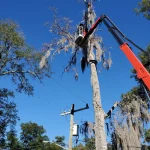
When removal is justified, Spanish moss can often be removed manually. Larger trees may require a bucket truck or other suitable equipment to reach the canopy safely.
The objective is to address the identified concern without causing unnecessary damage to the tree or removing more growth than needed.
-
Avoiding Unnecessary Chemical Treatments
Chemical treatment is generally unnecessary for Spanish moss growing on a healthy tree. Although certain copper-based products may control it, they can also injure sensitive foliage or nearby plants if used improperly.
Dead moss may remain tangled in the canopy after treatment and still require removal. Chemical control therefore does not necessarily eliminate the need for physical work.
Before considering a treatment, consult a qualified professional and follow all applicable product-label directions. The University of Florida IFAS Extension’s guidance on Spanish moss discusses the potential risks of chemical control and the importance of assessing whether removal is needed.
How Bushor’s Tree Surgeons Help Keep Jacksonville Trees Healthy
Spanish moss is part of the natural landscape in Jacksonville and throughout Northeast Florida. Most of the time, it does not require intervention. However, when a moss-covered tree also shows signs of structural damage or declining health, a professional assessment can help you determine the next steps.
Bushor’s Tree Surgeons serves homeowners and businesses throughout Jacksonville and surrounding communities. Our team includes ISA-certified arborists who assess tree health, evaluate structural concerns, and recommend appropriate care based on the condition of each tree.
Depending on the findings, our services may include:
- Tree health care: Identifying possible causes of thinning foliage, dieback, or other signs of decline.
- Tree risk assessments: Evaluating visible defects and potential hazards around homes and other structures.
- Tree trimming and pruning: Removing selected branches when necessary to improve tree structure or address specific concerns.
- Emergency tree services: Responding to hazardous branches and storm-related tree damage.
Our goal is to help property owners make informed decisions about tree care while avoiding unnecessary work. Call (904) 789-8884 or contact Bushor’s Tree Surgeons to discuss a tree concern or request an estimate.
Frequently Asked Questions
Do bugs and chiggers live in Spanish moss?
Spanish moss can provide shelter for insects and other small animals. Chiggers are more commonly associated with Spanish moss after it falls to the ground rather than moss hanging in a tree. If you collect fallen moss, wear gloves and avoid direct contact with your skin.
Can Spanish moss grow on dead trees?
Yes. Spanish moss uses trees as physical support and does not depend on them for nutrients. It can therefore grow on dead or dying trees, as well as on healthy ones. Its presence on a dead tree does not mean the moss caused the tree to die.
Is it illegal to remove Spanish moss in Florida?
Spanish moss removal from your own property is not generally prohibited simply because the plant is Spanish moss. However, rules can vary by location and circumstances, particularly on protected land or where other regulations apply. Check relevant local requirements before removing vegetation from public or protected property.
Does Spanish moss attract lightning to trees?
There is no good reason to assume that Spanish moss itself attracts lightning. Lightning risk is influenced by factors such as a tree’s height, location, and surrounding landscape. If a moss-covered tree has large dead branches or other structural defects, those concerns should be evaluated separately.
Can I use fallen Spanish moss as mulch in my garden?
Spanish moss can be used as an organic material in some gardening applications, but it is not a conventional substitute for every type of mulch. Consider the needs of your plants, how the material will break down, and whether the collected moss contains debris or unwanted organisms. Wear gloves when handling fallen moss and avoid spreading material if you suspect it may be contaminated.
Does Spanish moss need to be removed from healthy oak trees?
Usually not. Spanish moss is an epiphyte and generally does not harm healthy oak trees. Removal may be considered if dense growth shades foliage or makes it difficult to inspect a tree with suspected structural problems. An arborist can help determine whether intervention is necessary.
Can heavy Spanish moss cause tree branches to break during a storm?
Spanish moss usually contributes little weight compared with the structural forces that cause branch failure. However, a dense, wet accumulation may add some load to an already weakened branch. Cracks, decay, poor branch attachments, and storm conditions are important factors to assess before deciding whether pruning or moss removal is needed.
Do you provide tree services in Jacksonville and Jacksonville Beach, FL?
Yes, Bushor’s Tree Surgeons serves property owners in Jacksonville and Jacksonville Beach, FL, and surrounding Northeast Florida communities. Our services include tree trimming and pruning, tree health care, tree risk assessments, and emergency tree services. Learn more about tree service in Jacksonville and tree service in Jacksonville Beach, FL.