June 26, 2026
Key Takeaways
- Professional tree removal is a highly structured process that prioritizes site safety and property preservation.
- Comprehensive pre-work site preparation establishes vital drop zones and protects surrounding landscape features.
- The choice between sectional dismantling and traditional ground felling depends entirely on space and structural risk.
- Modern heavy equipment, including cranes and specialized rigging lines, enables precise control over heavy timber.
- Thorough post-removal cleanup ensures all debris is processed and the property is left clean and safe.
Tree removal is a complex engineering task that requires careful planning, technical precision, and specialized equipment. While property owners often view it as a simple matter of cutting down a trunk, the actual process involves a highly coordinated sequence of steps designed to protect human life and nearby property. Whether a tree is dead, structurally compromised, or interfering with construction projects, removing it requires an understanding of physics, wood mechanics, and safety protocols.
The Guide to Safe and Professional Tree Removal Extraction
When a professional tree removal company in Jacksonville, FL arrives at your property, they do not simply start starting up chainsaws. A successful project relies on a comprehensive assessment of the tree condition, its environment, and the surrounding architectural structures. From suburban backyards in Jacksonville to open commercial spaces, every property presents unique variables that dictate the extraction methodology.
By learning what happens during a professional tree removal job, you can better prepare your landscape coordinate with crews and ensure a smooth, stress-free experience. This step-by-step guide details exactly what to expect from the moment the specialized trucks arrive to the final site cleanup.
Step 1: Pre-Work Site Inspection and Safety Assessment
The removal process begins with a meticulous walkthrough of the entire work area. The crew leader examines the target tree and its immediate surroundings to identify potential hazards and establish a definitive operational plan. This initial inspection is critical for mitigating risks associated with falling timber and heavy equipment movement.
During this phase, the team specifically analyzes:
- The lean of the tree and its natural weight distribution
- Internal decay cavities, structural cracks, or weak branch unions
- Proximity to residential structures, fences, driveways, and delicate landscaping
- Overhead utility connections, including power, communication, and cable lines
- Ground obstacles such as underground septic systems, pools, or irrigation lines
Once these variables are evaluated, the crew leader establishes a clear drop zone where limbs and trunk sections will be directed. They also designate an explicit escape path for the chainsaw operators, ensuring a clear retreat route is available when final cuts are made. This step guarantees that every team member understands their role and coordinates seamlessly throughout the extraction.
Step 2: Equipment Deployment and Property Protection
Before a single cut is executed, the ground crew works to protect your lawn, landscaping, and hardscaping elements from heavy impact damage. Tree service machinery, including bucket trucks, cranes, and mini loaders, can place significant weight on driveways and turf if proper precautions are neglected.
Workers place heavy-duty outrigger pads and protective plywood mats over lawns and sensitive walkways to distribute the weight of the equipment evenly. This staging phase prevents deep rutting, soil compaction, and cracked pavement. At the same time, ground workers move outdoor furniture, potted plants, and lawn decorations completely out of the drop zone perimeter.
With the property secured, the crew positions the primary machinery. Depending on the complexity of the extraction, this may involve backing a bucket truck into position or deploying a large crane capable of reaching over a residential structure. Smaller specialized equipment, such as commercial wood chippers and debris trailers, is positioned near the street or driveway to facilitate rapid processing of waste material.
Step 3: Limbing and Sectional Canopy Dismantling
In suburban environments, whole tree felling is rarely an option due to spatial limitations. Instead, crews utilize a process known as sectional dismantling. This methodical technique involves removing the tree from the top down, starting with the outermost canopy branches and working down to the main trunk. A high-climb arborist ascends the tree using specialized ropes, harnesses, and climbing spikes or ascends via a bucket truck. As the climber cuts away individual limbs, they utilize an intricate system of high-tensile rigging blocks, pulleys, and friction brakes.
Ground workers anchor these rigging lines around the base of adjacent trees or specialized lowering devices. When the climber severs a branch, the rigging lines catch the weight suspended mid-air. The ground crew then slowly lowers the limb into the designated drop zone, preventing the heavy timber from free-falling onto lawns, fences, or structures below.
As limbs land in the drop zone, ground workers immediately process them using small chainsaws. They cut the branches into manageable sections and feed the foliage directly into a commercial wood chipper. The chipper processes the material instantly, turning bulky canopies into organic wood chips, which are blasted directly into a collection truck for hauling. This continuous ground clearing maintains a safe workspace and prevents debris accumulation.
Step 4: Trunk Removal and Strategic Section Cutting
Once the canopy branches are completely removed, only the main vertical trunk remains standing. Dismantling the trunk requires exceptional control as large log sections are incredibly dense and heavy, requiring precise cutting techniques to manage their descent.
The climber or bucket operator cuts the trunk into cylindrical sections commonly referred to as cookies or rounds. Working from the top down, the operator utilizes a series of strategic notch and back cuts to dictate exactly how each piece falls.
If the trunk is situated close to a home, a crane is often utilized to support the weight of each log section before the chainsaw cut is finalized. The crane operator lifts the heavy wood cylinder vertically away from the structure and lowers it gently onto the ground for processing. If space permits on the ground, log rounds are dropped onto heavy rubber landing mats to absorb the vibrational impact and protect the turf from deep indentations.
Step 5: Felling the Main Trunk (When Space Permits)
In situations where a property has an open field or a sufficiently large yard, the crew may choose to fell the main trunk in a single piece from the ground level. This traditional method is highly efficient but requires exact execution to control the direction of the fall.
The ground operator cuts a precise directional notch on the side of the trunk facing the intended fall zone. This notch acts as a guiding hinge. The operator then moves to the opposite side of the trunk and executes a flat back cut slightly above the hinge point.
As the back cut nears the hinge, the structural wood fibers begin to release, allowing gravity to pull the tree forward into the open zone. Operators use wedges driven into the back cut or pull lines anchored high in the tree to guarantee the trunk follows the intended path without twisting or kicking back off the stump.
Step 6: Log Processing and Ground Material Removal
With the entire tree dismantled or felled on the ground, the crew shifts its focus to processing the heavy timber. Large trunk sections cannot be put through a standard wood chipper, so they must be systematically cut into manageable logs.
Ground workers use large high-horsepower chainsaws to buck the trunk into sections that can be safely lifted by mini loaders or manual labor. Property owners can request to keep this wood for firewood, in which case the crew will stack the log rounds in a designated area on the property.
If the wood is not being kept, the team utilizes heavy loaders equipped with log grapples to transport the massive pieces to a debris trailer. These logs are hauled away to local recycling centers where they are repurposed into mulch, construction material, or biomass fuel, ensuring zero waste from the removal process.
Step 7: Final Site Clean-Up and Property Restoration
The hallmarks of a truly professional tree removal service in Jacksonville, FL are the quality and thoroughness of the final cleanup. A completed job site should look as though the tree care company was never there, with your outdoor space left immaculate and hazard-free.
Crew members utilize commercial leaf blowers, heavy-duty rakes, and magnetic sweepers to clear the entire workspace. They remove all residual sawdust, wood chips, twigs and fine bark fragments from your lawn, flower beds, driveways and sidewalks. The team also inspects the lawn to ensure no tools, rigging ropes or safety markers are left behind.
Once the area is completely cleared the crew leader conducts a final walkthrough with the homeowner to review the completed project. This ensures full customer satisfaction and guarantees that all access gates are secured and the property is safe for children, pets and daily use.
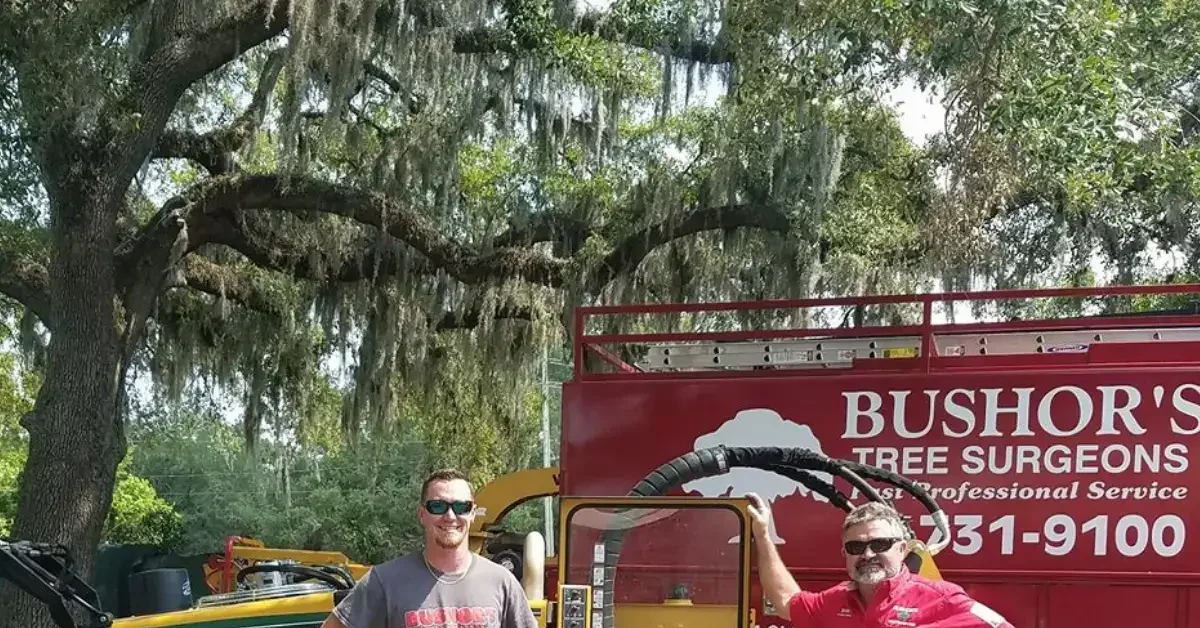
Executing a complex tree removal safely requires an experienced team backed by proper certifications and elite equipment. Bushor’s Tree Surgeons has been protecting residential and commercial properties throughout Northeast Florida since 1962. Our expert team features ISA Certified Arborists who bring generations of hands-on experience to perform professional tree trimming & pruning, tree health care, stump grinding & removal, hazardous tree removal, storm damage cleanup, arborist consultations, cabling and bracing, and 24/7 emergency tree services across Duval, Clay, and St. Johns counties.
We utilize modern crane bucket trucks and advanced rigging to protect your property during high risk extractions. Trust our safety first crews to handle your project efficiently from initial planning to immaculate cleanup. Book your Free Estimate Now with Bushor’s Tree Surgeons to discuss your queries regarding our tree removal process or prices.
Frequently Asked Questions About the Tree Removal Process in Jacksonville, Florida
Do I need a permit to remove a tree from my property in Jacksonville, Florida?
Yes, local municipalities in Northeast Florida often require specific permits for removing protected tree species or trees over a certain diameter. An ISA Certified Arborist can evaluate your local zoning laws and assist you with the proper application documentation.
How long does a standard residential tree removal job take to complete?
A standard tree removal can take anywhere from two hours to a full day depending on the size of the tree, its structural health and closeness to nearby homes. The crew leader will provide an estimated timeline during your initial consultation.
Will heavy tree removal equipment cause permanent damage to my lawn?
Professional crews minimize lawn impact by deploying protective plywood mats and heavy duty outrigger pads beneath all machinery tires. This staging distributes heavy weights evenly preventing deep ruts compaction and hardscape cracking.
What is the difference between traditional felling and sectional tree dismantling?
Traditional felling involves dropping the entire trunk in one piece from the ground which requires wide open space. Sectional dismantling involves taking the tree down piece by piece from the top down using ropes and rigging lines making it perfect for tight suburban spaces.
Is stump grinding automatically included in the cost of a tree removal?
Stump grinding is typically quoted as an independent service separate from the main tree removal project. If you want the stump removed below ground level ensure it is explicitly included in your initial written proposal.
What safety protocols do tree removal crews follow on a job site?
Professional crews follow strict safety guidelines including wearing personal protective equipment establishing explicit drop zones utilizing non conductive tools near lines and deploying coordinated rigging systems to manage heavy loads.
Can a tree be safely removed if it is located extremely close to a power line?
Yes but extractions near utility infrastructure require advanced rigging methods and close coordination with local power providers. Crews will often request the utility company temporarily drop or insulate service wires to ensure complete safety.
Should I be home on the property while the tree removal crew is working?
It is helpful to be present at the start of the project to confirm the scope of work with the crew leader but it is not mandatory. If you leave, ensure your gates are unlocked, pets are indoors and vehicles are cleared from the driveway.
Summary Checklist: Signs of Tree Disease and Structural Decline
| Tree Condition | Common Warning Sign | Potential Risk |
| Root Rot | Mushrooms near trunk base | Tree instability and collapse |
| Internal Decay | Hollow trunk or bark cracking | Structural failure during storms |
| Fungal Disease | Leaf spots or powdery mildew | Weakening overall tree health |
| Storm Damage | Broken limbs or trunk splits | Increased decay and safety hazards |
| Beetle Infestation | Bark holes and browning needles | Rapid canopy decline |
| Deadwood | Falling branches | Injury and property damage risks |
| Leaning Tree | Sudden trunk angle shift | Root failure |
| Sparse Canopy | Missing foliage sections | Disease progression or root stress |
Final Advice
Maintaining healthy trees in Jacksonville requires far more than occasional trimming or storm cleanup. Florida’s humid climate, heavy rainfall and frequent hurricanes create constant pressure on tree health making early diagnosis and preventive care essential for long term landscape safety. Ignoring warning signs such as fungal growth, leaning trunks, dead branches or thinning canopies can quickly lead to expensive emergency situations and major property hazards. The best approach is proactive maintenance supported by certified arborists who understand the biological and structural challenges unique to Northeast Florida trees.
Before hiring a reliable tree service in Jacksonville, FL, property owners should verify ISA certifications, licensing insurance coverage and experience handling Florida specific tree diseases and storm related risks. Proper pruning annual inspections, root management and rapid response to storm damage can significantly extend the lifespan of valuable trees while protecting nearby structures and outdoor spaces. If you need professional tree disease diagnosis, emergency tree service or arborist guided tree care anywhere in Jacksonville or Northeast Florida contact Bushor’s Tree Surgeons today for a free estimate.