June 26, 2026
Key Takeaways
- Misconceptions regarding tree care led to improper pruning, which permanently destroys structural stability.
- Tree topping creates fast-growing, weak limbs that easily fracture during tropical storms.
- Pruning paints and sealants trap moisture inside cuts, accelerating wood rot and fungal decay.
- Removing too much interior foliage (“lion-tailing”) alters a tree’s weight distribution and wind resistance.
- Relying on certified arborists prevents irreversible canopy damage and helps protect your residential property investment.
Tree pruning is one of the most vital maintenance practices for preserving the health, beauty, and structural safety of your residential landscape. However, it is also one of the least understood. Across Greater Jacksonville, well-meaning homeowners and uncertified landscape laborers routinely apply outdated techniques and misconceptions to their trees. In Northeast Florida‘s unique environment, where trees face extreme summer heat, high humidity, and intense tropical windstorms, a single pruning mistake can trigger a slow biological decline or cause sudden structural failure.
Many property owners view trees as static objects that can be chopped, shaped, or sheared without consequence. In reality, trees are complex living organisms that react dynamically to every single cut. Improper incisions disrupt a tree’s vascular system, create open pathways for invasive wood-boring pests, and leave branches vulnerable to decay. When these mistakes accumulate over time, a tree that should have stood for centuries can become a critical safety liability.
To safeguard your home and maintain a vibrant, healthy canopy, it is essential to separate fact from fiction. By debunking these eight common trees pruning myths, you can prevent expensive property damage and ensure your mature oaks, pines, and magnolias remain resilient for generations.
The Core Misconceptions Destroying Northeast Florida Canopies
To truly protect your landscape, we must examine the specific flawed practices that compromise local trees. Many of these habits are passed down through generations of property owners or promoted by unlicensed neighborhood handymen looking for a quick job. In the sections below, we break down the physiological reality of how trees react to poor maintenance. Understanding the science behind tree wounds will fundamentally alter how you view canopy management ahead of the next storm season.
Myth 1: Trees Should Be Topped to Control Height and Reduce Storm Risk
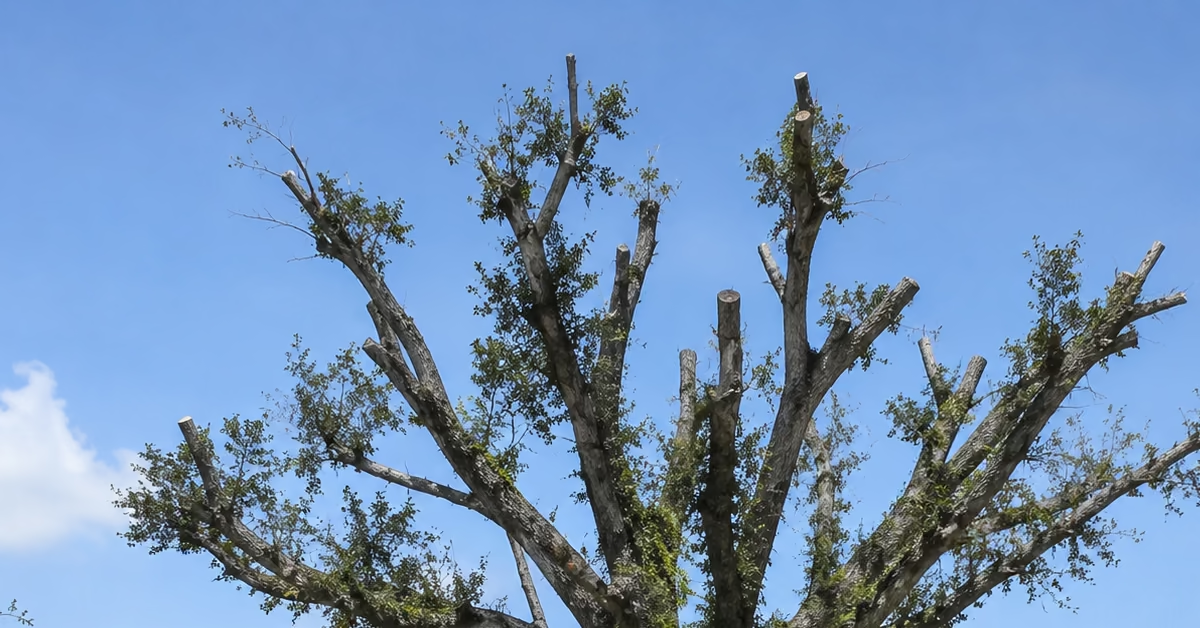
Perhaps the most destructive practice in modern tree care is tree topping, the indiscriminate cutting of main structural branches down to stubs. Homeowners often request this when they feel a tree has grown too tall or poses a threat to their roofline during hurricane season.
In reality, topping achieves the exact opposite of its intended goal. It shocks the tree by removing its primary food-producing foliage, forcing it to rapidly activate dormant buds. The resulting growth consists of weakly attached shoots called epicormic sprouts. These sprouts grow incredibly fast but lack a deep structural connection to the heartwood. Within a few years, a topped tree develops a dense canopy of unstable branches that are far more likely to snap and tear away during a tropical storm than the original canopy.
Myth 2: Pruning Paint or Wound Sealant Helps the Tree Heal Faster
For decades, traditional gardening advice dictated that large pruning cuts should be painted over with a thick, tar-like black sealant to protect the open wood from weather and disease. This myth persists today, with hardware store shelves still stocked with specialty wound dressings.
Modern arboriculture has proven that trees do not heal; instead, they compartmentalize wounds by growing a protective barrier of callus wood over the cut. Applying synthetic sealants interferes with this natural process. The dark coating traps moisture, fungal spores, and bacteria directly against the exposed wood, creating a damp, anaerobic environment that accelerates internal trunk rot. Except for very specific instances involving disease transmission control, all pruning wounds should be left open to dry and seal naturally.
Myth 3: You Can Safely Prune a Tree at Any Time of the Year
While dead or broken branches can be removed at any time for safety, structural pruning should be executed with careful seasonal timing. Many property owners assume that as long as they have the tools ready, any weekend is appropriate for trimming.
Pruning during the late summer or early fall can be highly detrimental to tree health. Late-season cuts stimulate a sudden flush of new, tender vegetative growth. This new growth does not have sufficient time to harden off before the cooler winter months, leaving the tree susceptible to frost damage. Furthermore, open cuts made during the peak of summer humidity coincide with the highest activity levels of wood-boring insects and fungal pathogens, significantly increasing the likelihood of infection.
Myth 4: Removing Interior Foliage Protects the Tree from Storm Winds
A common mistake made by uncertified tree cutters is a practice known as “lion-tailing.” This involves clearing out all the minor interior branches, twigs, and foliage along the lower and middle sections of main limbs, leaving a heavy tuft of leaves only at the absolute tips of the branches.
This practice is often marketed as a way to let wind pass safely through the tree. However, removing interior foliage strips away the tree’s natural shock absorbers. When strong winds hit a normal canopy, the interior leaves and twigs disrupt the airflow and dissipate the kinetic energy. A lion-tailed branch concentrates all the wind load at the heavy tip, causing the long, naked branch to whip violently back and forth until it splinters or pulls the tree out of the ground.
Myth 5: Flush Cuts are the Best Way to Remove a Limb Cleanly
When cutting a branch off entirely, it seems intuitive to cut it completely flat and flush against the main trunk to create a smooth appearance. However, executing a flush cut removes a vital piece of the tree’s anatomy: the branch collar.
The branch collar is the swollen ring of wrinkled bark where the branch joins the main stem. This area contains a high concentration of specialized chemically active cells that are solely responsible for sealing off wounds and preventing decay from spreading into the main trunk. Cutting through this collar bypasses the tree’s natural defense system, opening a direct pathway for deep wood rot to migrate into the core of the trunk, which permanently destroys its structural stability.
Myth 6: If a Tree is Young, It Doesn’t Need to Be Pruned Yet
Many homeowners believe that pruning is a maintenance task reserved exclusively for large, old trees. Young trees are often left to grow unchecked for their first decade under the assumption that they will naturally develop a strong shape.
In reality, the early developmental years are the absolute best time to prune a tree. Structural pruning on a young tree allows an arborist to establish a single dominant leader trunk, correct codominant stems, and eliminate crossing branches while the limbs are small. These minor, low-stress corrections prevent major structural flaws from developing later in life. Waiting until a tree is mature to fix a structural defect requires making massive cuts that jeopardize the tree’s survival and cost significantly more money to perform.
Myth 7: All Tree Species in Jacksonville Should Be Pruned the Same Way
A generic approach to tree care is highly dangerous because different species possess vastly different biologies, growth habits, and tolerances for stress. Treating a live oak the same way you treat a palm tree or a crape myrtle will quickly ruin your landscape.
For example, crape myrtles are routinely subjected to aggressive annual topping (commonly called “crape murder“), which ruins their natural form and results in weak, drooping blooms. Palms require a completely different approach; they should only be pruned to remove completely dead fronds that drop below a horizontal line, as over-pruning deprives them of vital potassium. Knowing the specific biological requirements of each local species is mandatory for achieving successful pruning results.
Myth 8: Anyone with a Chainsaw and a Truck Can Properly Prune a Tree
The belief that tree trimming is simple manual labor leads many property owners to hire cheap, uncertified door-to-door laborers. While anyone can mechanically saw a branch off a tree, doing so without an understanding of tree biology often inflicts irreversible damage.
Arboriculture is an established science that requires rigorous training, study, and adherence to national safety and quality standards. Certified professionals utilize specialized rigging, mathematically calculate weight shifts, and understand precise cutting angles to minimize biological stress. Hiring a certified tree pruning company in Jacksonville, Florida helps protect your trees’ health and reduces financial liability if an uninsured worker damages your home or utility lines.
Protecting your property from the long-term damage caused by improper pruning requires experienced professionals who understand tree biology. Bushor’s Tree Surgeons has been dedicated to preserving the magnificent urban canopy of Greater Jacksonville since 1962. Our multi-generational family company features three ISA Certified Arborists who bring over 100 years of combined experience to every job. Operating 24/7 with a fully equipped fleet, our licensed and fully insured teams deliver wide range of tree care services like – professional tree trimming & pruning, tree health care, stump grinding & removal, hazardous tree removal, storm damage cleanup, arborist consultations, cabling and bracing, and 24/7 emergency tree services across Duval, Clay, and St. Johns counties.
We refuse to use destructive practices like topping or lion-tailing, ensuring your trees remain safe and resilient. Book your Free Estimate today with Bushor’s Tree Surgeons today to discuss your tree care needs.
Frequently Asked Questions About Tree Pruning in Jacksonville, Florida
What is the correct way to cut a branch without tearing the bark?
Professional arborists utilize a three-cut method. The first cut is a small undercut placed a few inches out from the trunk to prevent the bark from peeling. The second cut removes the bulk of the branch weight further down the limb. The final cut cleanly removes the remaining stub just outside the branch collar.
How much of a live tree canopy can safely be removed during a single pruning?
As a general rule, you should never remove more than twenty-five percent of a mature tree’s live canopy during a single season. Removing too much foliage deprives the tree of its ability to photosynthesize, shocking its root system and causing rapid decline.
When is the ideal time of year to prune mature live oaks in Florida?
The absolute best time to perform extensive structural pruning on live oaks is during their dormant winter period, typically from December through February. This minimizes sap bleeding and ensures the wounds begin sealing before spring pests emerge.
What are codominant stems, and why are they considered dangerous?
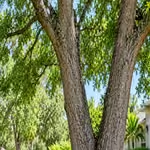
Codominant stems occur when a tree trunk splits into two or more main branches of equal size growing close together. As the tree grows, bark becomes trapped between the stems, creating a weak structural joint that is highly prone to splitting open during high winds.
Can a tree that has been severely topped ever be repaired?
Recovery takes years of specialized structural restoration pruning. An arborist must carefully select the strongest epicormic sprouts to become the new dominant leaders while systematically thinning out competing branches over multiple seasons.
How can I tell if an uncertified worker is trying to use a harmful pruning method?
Be alarmed if a worker suggests cutting main trunks down to bare stubs, clearing out all interior foliage while leaving heavy tips, or making cuts completely flush against the main bark of the trunk.
Why do palm trees require a unique approach to summer trimming?
Palms pull vital nutrients, particularly potassium, from their older green fronds to fuel new growth at the top. Pruning away green fronds simply because they point downward starves the palm, narrowing the trunk and leaving it weak.
Is it necessary to sanitize pruning tools between cutting different trees?
Yes, sanitizing blades with an alcohol or bleach solution between trees is critical. This prevents the accidental transmission of highly contagious vascular diseases, such as oak wilt or bacterial leaf scorch, from an infected tree to a healthy one.
Summary Checklist: Common Pruning Faults and Structural Risks
| Pruning Action | Immediate Consequence | Long-Term Hazard Level |
| Tree Topping | Forces weak epicormic sprouts | Critical storm failure risk |
| Flush Cutting | Bypasses the branch collar | Severe trunk rot and decay |
| Lion-Tailing | Shifts weight to branch tips | High risk of limb snapping |
| Wound Painting | Traps moisture against cuts | Accelerated fungal infection |
| Over-Pruning | Shocks vascular and root systems | Canopy dieback and structural decline |
| Tool Neglect | Spreads plant pathogens | Moderate to high disease risk |
| Neglecting Youth | Allows poor structure to form | High risk of future splitting |
| Bad Timing | Triggers frost-sensitive growth | Leaf decline and stem dieback |
Final Advice
Maintaining healthy trees in Jacksonville requires far more than occasional trimming or storm cleanup. Florida’s humid climate, heavy rainfall, and frequent hurricanes create constant pressure on tree health, making early diagnosis and preventive care essential for long-term landscape safety. Ignoring warning signs such as fungal growth, leaning trunks, dead branches, or thinning canopies can quickly lead to expensive emergencies and major property hazards. The best approach is proactive maintenance supported by certified arborists who understand the biological and structural challenges unique to Northeast Florida trees.
Before hiring any tree service company, property owners should verify ISA certifications, licensing, insurance coverage, and experience handling Florida-specific tree diseases and storm-related risks. Proper pruning, annual inspections, root management, and rapid response to storm damage can significantly extend the lifespan of valuable trees while protecting nearby structures and outdoor spaces.
If you need a reliable tree service firm in Jacksonville or Northeast Florida, contact Bushor’s Tree Surgeons today for a free estimate.