May 11, 2026
Northeast Florida sits squarely in hurricane territory, and the trees around your home are both an asset and a risk. A healthy, well-structured tree can ride out a storm and even shelter your house; a weak or neglected one can drop limbs on your roof or fail at the roots. The work that protects your property happens before the season, not during the warning. This guide covers how to spot vulnerable trees, which species hold up, what pruning helps (and what hurts), and what to do before and after a storm.
Start Early: Why Pre-Season Matters
Hurricane season runs June through November, with peak activity from August to October. The time to act is late winter through spring well before a storm is named. Trees pruned or cabled at the last minute are more vulnerable, not less, because fresh cuts and disturbed canopies need time to recover. Book a tree risk assessment early in the year when crews have availability.
Spotting Weak and High-Risk Trees
Before a storm approaches, walk your property and look for the trees most likely to fail:
- Dead, hanging, or broken limbs, and large deadwood in the canopy.
- A sudden or worsening lean, or soil lifting at the base.
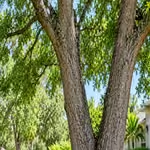
- Cracks in the trunk, or weak V-shaped forks with included bark (bark pinched inside the union).
- Mushrooms or conks at the base are a sign of internal root or trunk rot.
- Fast-growing, weak-wooded species near the house are also the trees most likely to fall in a storm.
- Trees with recent root damage from construction, trenching, or new driveways.
Which Trees Survive Storms and Which Don’t
After Florida’s intense 2004–2005 hurricane seasons, University of Florida researchers surveyed which species held up. The most wind-resistant included live oak, sand live oak, bald cypress, and southern magnolia deep-rooted, strong-wooded natives. The poorest performers included water oak, laurel oak, sand pine, and non-native Bradford pear, which snap or uproot readily. Two lessons follow: give extra scrutiny to the weak-wooded species already on your lot, and when planting, choose storm-resistant species for Northeast Florida. Trees also fare far better in groups than as isolated specimens, because a cluster shares the wind load.
Pruning That Helps and Pruning That Hurts
Correct structural pruning reduces a tree’s wind resistance and removes hazards. The goal is to thin and balance the canopy so wind passes through it, keep a single dominant leader, and remove deadwood and crossing or weakly attached limbs. Building that structure early while a tree is young is the cheapest, most effective storm protection there is. This is a job for professional tree trimming following ANSI A300 standards.
What hurts: topping. Cutting large limbs back to stubs — topping or “hat-racking” — is one of the worst things you can do before a storm. It forces weak, densely attached regrowth that fails easily in future wind, starves the tree, and opens large wounds to decay. The International Society of Arboriculture explicitly condemns topping. Never let anyone top your trees in the name of storm safety.
Cabling, Bracing, and Support
Structurally valuable trees with weak unions or heavy horizontal limbs can often be retained with cabling and bracing rather than removed. Hardware installed by a trained arborist redistributes load and reduces the chance of a limb or fork failing in high wind. It’s not a fix for a dying or root-failed tree — those should be removed before the season.
Before a Storm Hits
- Finish any planned pruning and cabling well ahead of an approaching system — don’t start tree work once a storm is named.
- Remove or secure loose yard items; clear gutters and drains of leaves and debris.
- Do a final look for obvious hazards — dead limbs over the roof, driveway, or power area. Never work near lines yourself.
- Photograph your trees and property; date-stamped images help if you need to file an insurance claim later.
Homeowners across St. Johns and Fleming Island should book early, since crews fill up fast once a system is in the forecast.
After the Storm
Once it’s safe, check trees from a distance for new leans, hanging limbs (“widow-makers”), split trunks, and lifted roots. Stay away from any tree touching a power line and from limbs under tension, which can spring when cut. Don’t rush to remove a storm-stressed but standing tree — many recover with proper care. For downed trees, hanging limbs, or blocked access, our emergency tree service and storm damage cleanup crews handle removal and clearing safely.
Frequently Asked Questions About Storm & Hurricane Tree Prep in Jacksonville, FL
When should I prepare my trees for hurricane season?
Late winter through spring before the June–November season. Pruning and cabling need time to settle, and crews are far easier to book before storms are in the forecast.
Does topping a tree make it safer in a hurricane?
No the opposite. Topping forces weak regrowth that fails more easily in future storms and wounds the tree. Proper structural pruning is what reduces wind risk.
Which trees are most likely to fail in a Jacksonville storm?
Fast-growing, weak-wooded species like water and laurel oaks, sand pine, and Bradford pear, plus any tree with deadwood, a new lean, trunk cracks, or root rot. A risk assessment identifies them.
Can a weak tree be saved instead of removed?
Often yes, structurally sound trees with weak limbs or forks can be retained with cabling and bracing. Trees with root failure or decay should be removed before the season.
What should I do with storm-damaged trees?
Keep clear of anything near power lines or under tension and call professionals. Our storm damage cleanup team handles downed and hanging trees safely.
Sources & Credible References
- National Hurricane Center (NOAA) → https://www.nhc.noaa.gov/
- UF/IFAS — Selecting Tree Species for Wind Resistance (Duryea) → https://edis.ifas.ufl.edu/
- International Society of Arboriculture — Trees Are Good → https://www.treesaregood.org/
- Tree Care Industry Association (TCIA) → https://www.tcia.org/
- Florida Forest Service → https://www.fdacs.gov/Forest-Wildfire