5525 St. Augustine Rd, Jacksonville,
FL 32207

Open 24/7

Arborist inspecting exposed roots after a Florida rainstorm.

Key Takeaways

  • Waterlogged soil can weaken the connection between tree roots and the ground that anchors them.
  • A new or worsening lean is more concerning than a long-standing natural lean.
  • Raised soil, root exposure, cracks, gaps, and movement near the trunk can indicate root-plate failure.
  • A tree may continue producing green leaves even when its root system is unstable.
  • Homeowners should avoid unstable trees and arrange a professional assessment after significant movement.

Heavy Florida rain does more than fill drainage ditches and create standing water in low areas. When soil remains saturated around a tree, the ground can lose some of its ability to hold the root system in place. That loss of support becomes especially concerning when the tree already has decay, construction damage, compacted soil, shallow roots, or a heavy one-sided canopy.

Jacksonville property owners often look at the leaves first when deciding whether a tree is healthy. After heavy rainfall, however, the most important warning signs may be at the base of the trunk. A tree can remain green and appear vigorous while its anchoring roots have started to move. Learning how to recognize soil movement and a new lean can help homeowners respond before a tree fails onto a house, vehicle, driveway, fence, road, or outdoor living area.

Why Saturated Soil Affects Tree Stability

Tree roots need water, but they also need oxygen. In healthy, well-structured soil, air spaces allow oxygen to move around the roots. When heavy rain fills those spaces with water, oxygen becomes less available. Prolonged saturation can injure fine roots, reduce root function, and encourage decay in damaged tissue.

Waterlogged soil can also become physically weaker. The roots may still be present, but the soil surrounding them may no longer provide the same resistance against movement. Wind, the weight of a wet canopy, or the force of another storm can then push the tree beyond the point where its root system can hold it upright. The risk varies from one property to another. Sandy soil may drain relatively quickly, while compacted or poorly graded soil can remain wet for days. Trees near ponds, drainage channels, slopes, excavations, or construction areas may face additional instability. A tree that has survived previous storms is not necessarily safe. Repeated wetting and drying can weaken both the roots and the soil around them over time.

How Root Damage Develops

Root problems rarely begin with one dramatic event. They often develop through several stresses that accumulate.

  • A tree may lose roots during driveway construction, utility trenching, pool installation, foundation work, or grading. 
  • Compacted soil can reduce oxygen and make it difficult for new roots to grow. Poor drainage can keep the root zone saturated, while drought periods can stress the remaining roots.
  • Decay organisms may enter damaged roots and gradually reduce their strength. 
  • The canopy may continue to look normal because trees can draw on stored resources and maintain leaves for a period after root damage occurs. This delayed response is one reason homeowners may be surprised when a green tree begins leaning after a storm. 
  • The rain may not have caused the entire problem. It may simply have exposed instability that was already developing underground.

The Difference Between a Natural Lean and a New Lean

Many trees grow with some degree of lean. A tree may develop toward sunlight, respond to competition, or grow at an angle because of its original planting position. A long-standing, stable lean is not automatically a sign of imminent failure. The more important question is whether the angle has changed.

  • A new lean after heavy rain, strong wind, or nearby excavation deserves prompt attention. So does a lean that has become noticeably worse over a period of weeks or months.
  • Homeowners can compare the tree with older photographs, fence lines, roof edges, or nearby vertical features. 
  • If the trunk or canopy has shifted relative to those fixed objects, contact an arborist rather than assuming the change is harmless.

Warning Signs Around the Root Flare

  • The root flare is the area where the trunk widens as it transitions into the main roots. It is one of the most useful places to look after heavy rain.
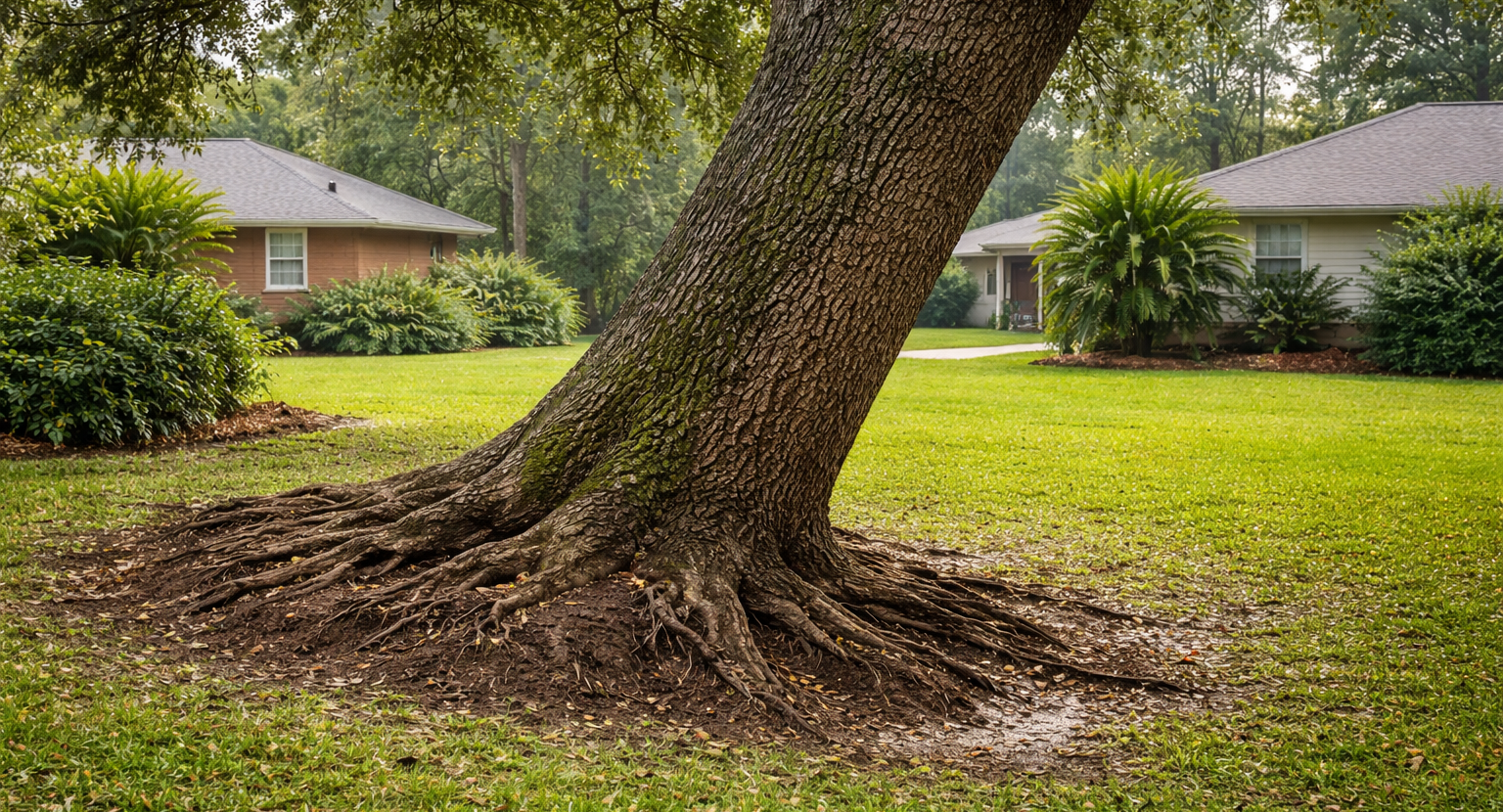
  • Freshly exposed roots can indicate that soil has pulled away from the root system. Cracks radiating through the soil may show that the root plate has shifted. Raised ground on the side opposite the lean can mean that roots are lifting as the tree rotates.
  • Other signs include – gaps between roots and soil, broken or torn roots, a tilted root flare, and water pooling in a way that was not typical before the storm.
  • Soil heaving is especially concerning. When the ground rises on one side of the base, the root plate may be lifted out of the soil. The tree may still appear attached, but the connection that keeps it upright could be failing.
  • Do not smooth over heaved soil or push the root plate back into place with heavy equipment. Those actions can create additional root damage and place people in the tree’s potential failure zone.

Trees That Deserve Extra Attention

Waterlogged soil can affect any tree, but certain conditions increase concern. Large mature trees have greater weight and a larger failure zone. Trees with dense crowns may catch more wind, while trees with one-sided canopies may place uneven stress on their roots.

Pay particular attention to trees that have:

  • A history of root cutting.
  • Visible decay or fungal growth.
  • Cavities or trunk cracks.
  • Heavy deadwood.
  • A severe or changing lean.
  • Roots near recent construction.
  • A location beside a slope or drainage channel.
  • A canopy that has been heavily reduced or topped.
  • Soil that repeatedly stays saturated.

Species and site conditions also matter. Trees adapted to wet areas may tolerate saturation better than species planted in locations that remain waterlogged. Even a moisture-tolerant tree, however, can become hazardous if its roots are decayed or physically disturbed.

Why a Green Canopy Does Not Prove Safety

Leaves show that some living tissue remains in the crown. They do not prove that the root plate is stable. A tree can maintain a green canopy while losing major structural roots. In some cases, the canopy may remain healthy until the tree fails. This is why homeowners should not dismiss a new lean simply because the leaves look normal.

The opposite is also true: a tree with sparse foliage is not automatically about to fall. Canopy decline may reflect drought, disease, pests, root stress, or seasonal conditions. An arborist must evaluate the entire tree, including the roots, trunk, branches, crown, and surrounding targets.

What to Do After Heavy Rain

  • If a tree has developed a new lean, keep people and pets away from the area. 
  • Do not park beneath it, place outdoor furniture in the potential fall zone, or walk around the base to inspect it closely.
  • Avoid cutting branches, climbing the tree, attaching ropes, or attempting to pull it upright. A tree with a shifting root plate can move unexpectedly, and branches may be under tension.
  • If the tree is near electrical lines, remain clear and contact the utility provider when appropriate. Utility work and tree work near energized lines require specialized procedures.
  • Take photographs from a safe distance. Include the entire tree, the base, the surrounding soil, and nearby structures. Then contact a qualified arborist or professional tree service.
  • The assessment may result in a recommendation to monitor the tree, prune selected branches, install support, improve site conditions, or remove the tree. 
  • The safest recommendation depends on whether the root plate is still stable and what the tree could strike if it failed.

Drainage Improvements Are Not Always the First Step

  • Homeowners often respond to waterlogged soil by digging trenches, adding fill, or redirecting water. These actions may be useful in some situations, but they can also harm roots or change the tree’s stability.
  • Adding soil over roots can reduce oxygen. Excavating around the base can sever anchoring roots. Redirecting water may create new erosion or send runoff toward a foundation or neighboring property.
  • The tree should be evaluated before drainage work begins. An arborist can identify the root zone and explain which types of soil disturbance could create additional risk. 
  • A drainage professional may then be needed to design a solution that accounts for the tree, structures, grading, and local conditions.

When Removal Becomes the Safest Option

Preservation is often the preferred outcome when a tree is healthy and stable. However, removal may be the safest choice when the root plate has lifted, the tree is leaning toward a target, decay is extensive, or the tree cannot be stabilized. A tree that has already shifted may not be restored by pruning alone. Reducing the canopy can lower some wind load, but it cannot replace damaged roots or reconnect a lifted root plate to firm soil. Removal should be planned rather than improvised. An experienced tree service firm in Florida may need to dismantle the tree in sections, use ropes or a crane, protect nearby structures, and control access to the site.

At Bushor’s Tree Surgeons, we help Jacksonville homeowners assess trees that may have become unstable after heavy rain or storms. Our certified arborists can inspect leaning trees, exposed roots, soil movement, and other signs of root-plate instability. We can determine whether a tree may be safely monitored, pruned, supported, or requires removal. 

Our experienced crews can also handle hazardous tree removal while taking care to protect your home, driveway, landscaping, and surrounding property. If you notice a newly leaning tree after heavy rain, Bushor’s Tree Surgeons can assist in conducting a professional assessment before the situation becomes more dangerous. 

Frequently Asked Questions About Leaning Trees in Florida

Can a mature tree straighten itself after heavy rain?

A mature tree with a new lean should not be expected to straighten itself. Some young trees may correct a minor lean, but movement in a large tree can indicate root damage or root-plate failure.

Should I stake a leaning tree?

Staking may help some newly planted trees, but it is not a reliable repair for a mature tree with compromised roots. Improper staking can add pressure to the trunk, restrict natural movement, or create a false sense of security.

Is standing water around a tree always dangerous?

No. Some trees tolerate temporary saturation, and a brief period of standing water does not automatically mean the tree will fail. Concern increases when water remains for extended periods or is combined with decay, a new lean, exposed roots, or soil heaving.

Can pruning make a leaning tree safe?

Pruning may reduce the weight or wind resistance of certain branches, but it cannot repair a failed root system. The tree’s stability must be assessed before pruning is recommended.

How quickly should a storm-leaning tree be inspected?

Contact an arborist as soon as practical, especially if the tree leans toward a structure, road, driveway, power line, or area used by people.

Summary Checklist: Leaning Trees After Heavy Florida Rain

Situation What to Check What to Do
Tree has a new lean Direction and recent change in position Keep people away and request a prompt assessment
Soil is raised on one side Root-plate movement or lifting Treat the tree as potentially unstable
Cracks appear near the trunk Soil separation or root movement Avoid the area and contact an arborist
Roots are exposed Broken, torn, or lifted roots Do not cut or cover them without professional guidance
Standing water surrounds the base Drainage and length of saturation Evaluate the tree before changing the site
Tree leans toward a home or road Potential target within the failure zone Keep people and vehicles outside the area
Hanging branches are present Broken limbs or branches under tension Do not work beneath the canopy
Utility lines are nearby Electrical and access hazards Stay clear and contact the utility provider
Tree remains green Canopy condition versus root stability Do not assume the tree is safe because it has leaves
Root plate has lifted Soil heaving and trunk movement Arrange urgent professional evaluation

Final Advice

Heavy Florida rain can reveal a tree problem that developed gradually beneath the surface. A new lean, raised soil, exposed roots, cracks, or a lifted root plate should never be dismissed simply because the tree still has green leaves.

If a tree has shifted after rain, Bushor’s Tree Surgeons can evaluate the root plate, trunk, crown, and surrounding targets. We can explain whether the tree may be monitored or whether support, pruning, or removal is the safer course.

Reviewed by a Certified Arborist

This article has been reviewed by a certified arborist to ensure accuracy with the recommendations for Jacksonville’s waterlogged soil, rainfall, and storm conditions.

Sources & Credible References

Testimonials

What Our Clients Say

Quote

Shannon R.

Bushor’s Tree Surgeons Client

Google star

“This is THE best tree company in Jacksonville. They were willing to work around my schedule, they were efficient, knowledgeable, and affordable ... Their work exceeded my expectations and I can easily say that they were worth every penny for the amazing job they did.”

Quote

Dawn D.K.

Bushor’s Tree Surgeons Client

Google star

“Absolutely in awe! My husband and I could not be more pleased with the service we received. Bushor's Tree Surgeons are the cream of the crop. They arrived before 8am (outstanding) and completed the cutting, debris removal and cleaning of four huge pines before 4pm ... Thanks a million. Beautiful job.”

Quote

Nancy B.

Bushor’s Tree Surgeons Client

Google star

“Bushor's Tree Surgeons employs the best crew. We had the pleasure of seeing their work first hand. Additionally, the equipment used is first rate. There are 3 certified arborists on staff. Their knowledge is invaluable. Great company with equally great people.”

Quote

Bowman AC

Bushor’s Tree Surgeons Client

Google star

“Our experience with Bushor's was excellent! From scheduling the estimate, competitive pricing to clean up. The whole staff was very professional and pleasant to work with ... Bushor's is a top-notch company!”

Quote

Sara D.

Bushor’s Tree Surgeons Client

Google star

“I highly recommend Bushor's Tree Surgeons. They take pride in the work they do and it shows. We used them to remove trees, trim trees and cable a tree. They did such great work. The team was professional and friendly. Such a pleasure to work with. Their pricing is fair and competitive.”

Quote

Edward G.

Bushor’s Tree Surgeons Client

Google star

“EXTREMELY professional and pleasant to work with. They showed up exactly when they said they would, protected as many things as possible, including the lawn, before they commenced work, and completely cleaned up when they were done ... I would highly recommend Bushor's Tree Surgeons to anyone!”

You Can Trust The
Experts At Bushor’s
Tree Surgeons

Contact us

Book your free consultation

Ready to get those trees handled? Reach out for a free, no-obligation estimate. Our team responds quickly and works on your schedule, 365 days a year.

(904) 789-8884

Call or text anytime

5525 St. Augustine Rd, Jacksonville,
FL 32207

Serving all of Northeast Florida

Open 24/7 for emergencies

Ready 365 days a year

Request a Free Estimate

Fill out the form below, and we'll get back to you.